

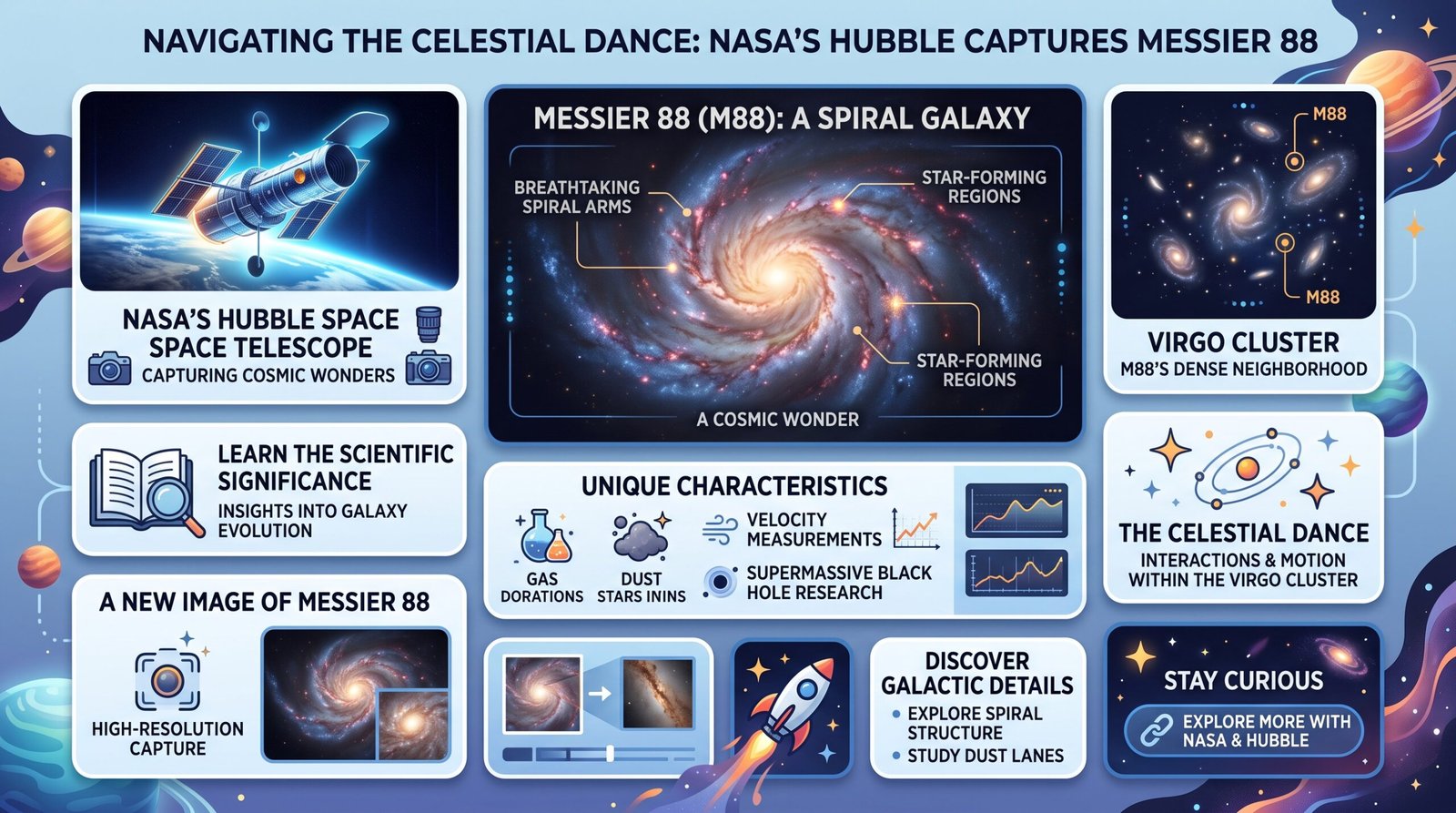
Navigating the Celestial Dance
Navigating the Celestial Dance: NASA’s Hubble Captures Messier 88
Discover how NASA’s Hubble Space Telescope has captured a breathtaking new image of Messier 88, a spiral galaxy that is part of the Virgo Cluster. Dive into the fascinating details of this cosmic wonder and learn about the scientific significance behind its unique characteristics.
About Messier 88
Messier 88, also known as NGC 4501, is a spiral galaxy located in the constellation Coma Berenices. This stunning celestial object has recently captured attention due to its active central supermassive black hole and its journey through the Virgo Cluster.
- Distance: Approximately 60 million light-years from Earth
- Diameter: Around 130,000 light-years in diameter
- Discovery: Discovered by Charles Messier on March 28, 1781
Scientific Significance and Key Features of Messier 88
Messier 88 is particularly significant for its active central black hole, which is estimated to be around 100 million times more massive than the Sun. The Hubble image reveals a bright glow produced by this supermassive black hole as it engulfs gas and dust. This process, known as accretion, provides astronomers with valuable insights into galactic evolution.
The photograph also showcases numerous old stars represented by red dots scattered across the galaxy’s spiral arms. The pink and blue hues depict star clusters and dust clouds, adding to the rich tapestry of Messier 88’s structure. These colors are a result of different wavelengths of light emitted from various stellar phenomena.
Impact on Nearby Galaxies
Messier 88’s journey through the Virgo Cluster has significant implications for both its own future and the galaxies it interacts with. As M88 approaches, gravitational forces will affect nearby celestial bodies, including the neighboring galaxy Messier 87.
- Proximity Effects: Already observed are the compression of gas on the outer edge of M88, leading to a phenomenon called ram pressure stripping. This process involves the gravitational pull from other galaxies in the cluster stripping away cold gas that fuels star formation in Messier 88.
- Future Projections: In about 200 million to 300 million years, M88 will reach its closest point to Messier 87. This proximity is expected to cause further disruptions and interactions between the two galaxies.
Common Mistakes in Studying Galaxies
Studying galaxies like Messier 88 can be complex, and there are several common mistakes that researchers might make:
- Misinterpreting Data: Misunderstanding the nature of accretion disks or misidentifying star clusters as other phenomena.
- Inaccurate Distance Estimates: Incorrectly calculating distances to galaxies can lead to inaccurate models and predictions about their behavior over time.
Best Practices for Galaxy Research
To ensure accurate research, astronomers follow several best practices:
- Utilize High-Resolution Telescopes: Utilizing advanced telescopes like Hubble can provide detailed images and accurate measurements.
- Interdisciplinary Collaboration: Collaborating with experts from various fields, such as astrophysics, cosmology, and mathematics, can lead to more comprehensive insights.
Useful Tips for Amateur Astronomers
Amateur astronomers can also contribute valuable observations and data. Here are some tips:
- Stay Informed: Follow astronomy news to stay updated on the latest discoveries and research methods.
- Join Communities: Participate in online forums or local astronomy clubs to connect with other enthusiasts and share knowledge.
Frequently Asked Questions (FAQ)
| Question | Answer |
|---|---|
| How does the supermassive black hole in Messier 88 affect its surroundings? | The black hole’s gravitational pull influences nearby matter, causing accretion and potentially leading to ram pressure stripping of gas. |
| What is the Virgo Cluster, and why is it important for studying galaxies like Messier 88? | The Virgo Cluster is a collection of thousands of galaxies. Studying such clusters helps us understand galaxy evolution and the effects of gravitational interactions on galactic behavior. |
Conclusion
Messier 88’s journey through the Virgo Cluster offers a fascinating glimpse into the dynamics of galaxy interaction and evolution. Through careful study using advanced telescopes like Hubble, we can gain valuable insights that contribute to our understanding of the universe.