

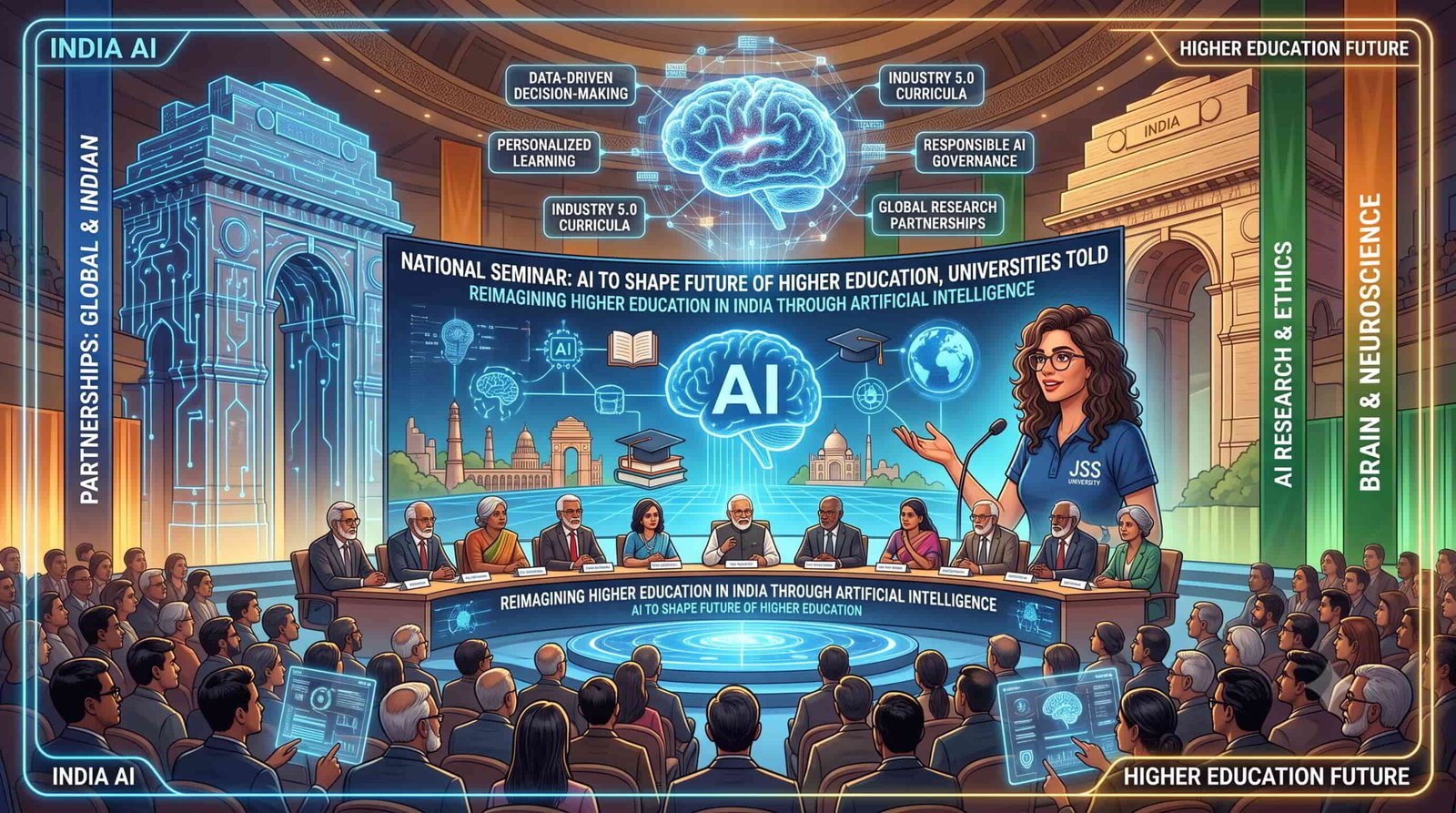
AI to Shape Future of Higher Education, Universities Told
Mysuru, May 30, 2026 – JSS Science and Technology University (JSS STU) in Mysuru has successfully organized a one-day national seminar on “Reimagining Higher Education in India through Artificial Intelligence,” bringing together more than 40 former Vice-Chancellors representing universities across Karnataka, distinguished academicians, education leaders, industry experts, researchers, and policymakers to deliberate on the transformative role of AI in reshaping higher education institutions in India.
Opening Remarks
Dr. B. Suresh, Pro-Chancellor of JSS Academy of Higher Education & Research (JSS AHER) and Director of the Technical Education Division, JSS Mahavidyapeetha, inaugurated the conference. In his address, Dr. Suresh highlighted the immense potential of AI in transforming universities and academic institutions. He emphasized that AI can significantly enhance teaching-learning pedagogy, improve student engagement, enable personalized learning experiences, and support data-driven academic decision-making.
Keynote Address
Dr. A. N. Santosh Kumar, Vice-Chancellor of JSS STU, Mysuru, underscored the importance of embracing emerging technologies to prepare students and institutions for the future knowledge economy.
Delivering the keynote address, Dr. Jayakumar Singaram, general manager of Signal Processing at Mistral Solutions Pvt. Ltd., spoke extensively on the growing impact of AI in education. He outlined the evolving requirements of the education sector in the AI era and emphasized the need for universities to adapt their curricula, research priorities, faculty development initiatives, and learning methodologies to meet the expectations of Industry 5.0 and the rapidly changing technological landscape.
Expert Sessions
- A panel discussion involving eminent academicians and former Vice-Chancellors explored strategies for integrating AI into university ecosystems while ensuring ethical and responsible adoption.
- The seminar featured a series of expert sessions covering diverse themes including AI as a strategic lever in higher education leadership, AI in teaching-learning and academic innovation, AI-driven research and funding opportunities, industry expectations from universities in the AI age, and AI-enabled digital libraries for higher education institutions.
Consensus
The seminar concluded with a consensus that Artificial Intelligence will be a defining force in the future of higher education. The president of the Forum of Former Vice-Chancellors of Karnataka, Dr. S. Chandrashekar Shetty, emphasized the importance of collaborative efforts among academia, industry, and policymakers to harness AI for improving educational quality and accessibility.
Technical Implications
The seminar underscored the technical implications that AI can have on higher education institutions. According to experts, AI has the potential to revolutionize how universities operate by enabling more efficient administrative processes, personalized learning experiences through adaptive technologies, and research methods that leverage big data analytics.
Dr. Suresh emphasized the need for Vice-Chancellors and academic leaders to integrate AI into institutional policies, governance, curriculum design, research, and administration. He highlighted that redesigning the entire educational infrastructure—from classrooms and laboratories to digital learning ecosystems—must be done with emerging AI-enabled teaching and learning processes in mind.
Market Impact
The market for AI solutions in education is expected to grow significantly. According to a recent report by MarketsandMarkets, the global AI in education market size was valued at $14.6 billion in 2023 and is projected to reach $57.7 billion by 2028, growing at a CAGR of 29.5% during the forecast period.
Expert Perspectives
“The integration of AI into higher education can lead to more efficient and effective learning environments,” said Dr. Jayakumar Singaram, general manager of Signal Processing at Mistral Solutions Pvt. Ltd.
Industry experts believe that the adaptation of AI in educational institutions is crucial for preparing students for the future workforce. “AI technologies like natural language processing, machine learning, and predictive analytics can provide insights into student performance, enabling educators to tailor their teaching methods accordingly,” added Dr. Suresh.
Conclusion
The seminar highlighted that AI has the potential to transform higher education in India by enhancing pedagogical practices, improving administrative efficiency, and providing personalized learning experiences. The consensus among participants is that universities must embrace this technology proactively to remain relevant in the digital age.