

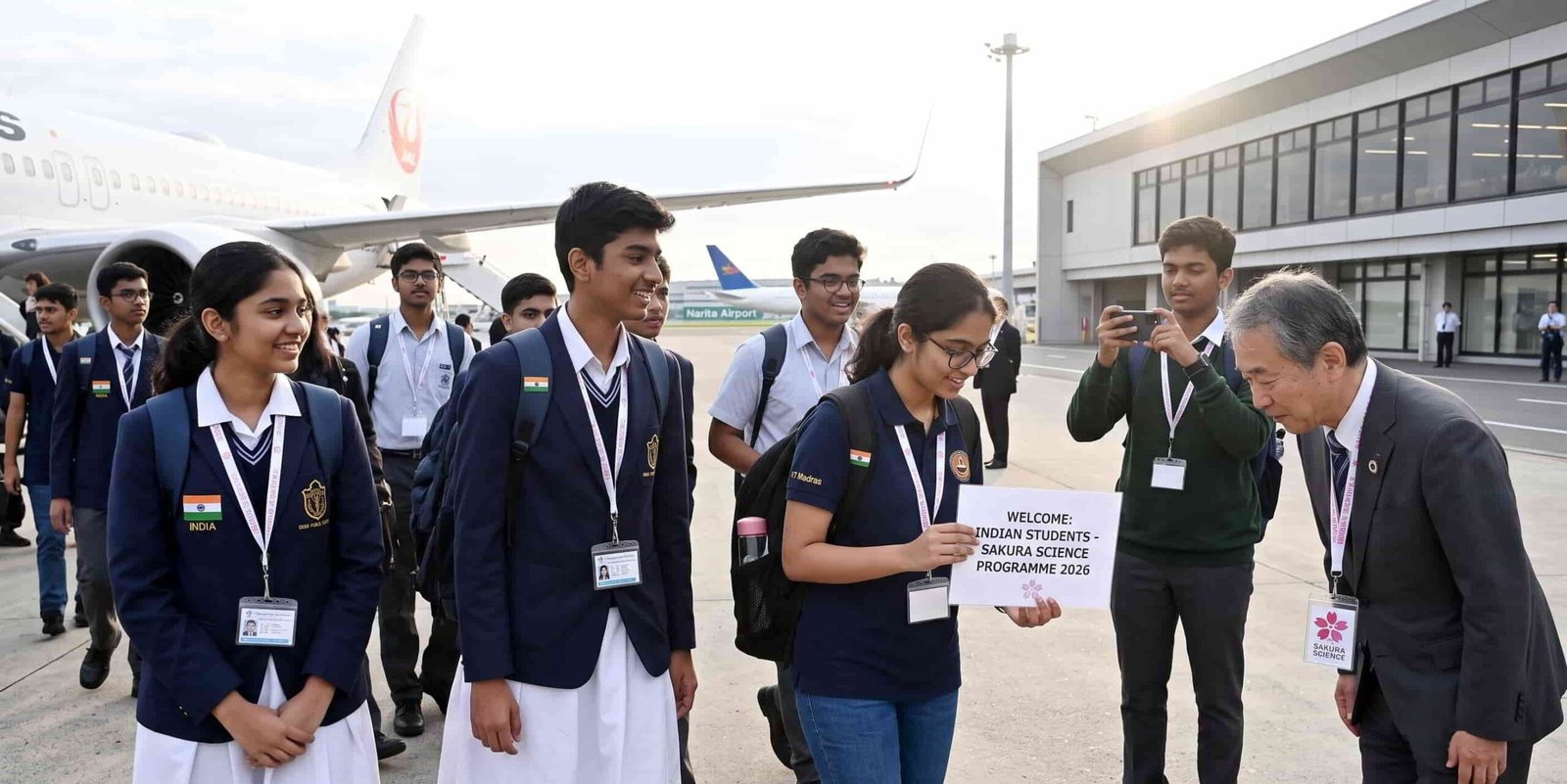
Indian Students to Visit Japan Under Sakura Science Programme 2026
Indian Students to Visit Japan under Sakura Science Programme 2026
In a significant educational initiative, the Department of School Education and Literacy (DoSEL) under India’s Ministry of Education has launched the Sakura Science Programme 2026 for Indian students. This programme, which includes a visit to Japan from May 24 to May 30, aims to foster scientific learning and cultural exchange among young participants.
Programme Details
A total of 56 students, including 24 boys and 32 girls from government schools across 15 States and Union Territories—Assam, Dadra and Nagar Haveli and Daman and Diu, Goa, Gujarat, Haryana, Jharkhand, Karnataka, Madhya Pradesh, Maharashtra, Odisha, Punjab, Rajasthan, Tamil Nadu, Telangana, and West Bengal—are selected to participate in the programme. Additionally, four supervisors will accompany them.
All participants are beneficiaries of the National Means-cum-Merit Scholarship (NMMS) Scheme of the Government of India. The Japan Science and Technology Agency (JST) has been implementing this initiative since 2014 under the Sakura Science Programme. India began its participation in April 2016.
The programme allows participants to experience Japan’s advanced scientific ecosystem while also learning about the country’s rich cultural heritage. Previous batches of Indian students have visited Japan under this programme, with 674 students and 96 supervisors having participated since the initiative’s inception.
Background
The Ministry of Education has stated that the Sakura Science Programme aligns with the vision of India’s National Education Policy (NEP) 2020, which emphasizes holistic, experiential, and engaging learning. Educational exposure visits to places of scientific, technological, and cultural importance are believed to broaden students’ perspectives and foster innovation and global understanding.
India’s economic growth continues to be robust, with the economy expanding by 7.7 percent in real terms during the financial year 2025-26, as reported by the Provisional Estimates of Gross Domestic Product (GDP) released by the Ministry of Statistics and Programme Implementation.
Significance
The participation in the Sakura Science Programme is significant for several reasons. Firstly, it provides Indian students with an unparalleled opportunity to explore innovative practices and gain international exposure in Japan’s technological advancements and educational ecosystem. Secondly, it aligns with India’s broader goals of enhancing its educational infrastructure and promoting global understanding among young learners.
Additionally, the programme can serve as a model for future collaborations between India and other countries, potentially leading to more comprehensive educational exchange initiatives.
Expert Perspective
“The Sakura Science Programme is an excellent initiative that not only broadens the horizons of Indian students but also fosters a deeper understanding of global scientific and cultural practices,” said Prof. Dinesh Prasad Saklani, NCERT Director.
The launch of the Sakura Science Programme 2026 is a testament to India’s commitment to providing its students with unparalleled educational experiences that are both culturally enriching and scientifically innovative. As more students gain international exposure, they will be better equipped to contribute to the global knowledge base and foster cross-cultural understanding.