
Machine Learning: 7 Critical Evaluation Metrics, Boost Your Model’s Performance by 40%
Introduction: Why Evaluation Metrics Matter
Machine learning evaluation metrics are fundamental tools that determine the success and real-world applicability of AI models. According to a 2023 survey by Kaggle, 87% of data scientists reported that selecting appropriate evaluation metrics significantly impacted their project outcomes. These metrics serve as the critical compass guiding model development, helping practitioners understand not just if a model works, but how well it works for specific business contexts.
The challenge lies in the no-one-size-fits-all nature of evaluation metrics—what works perfectly for a fraud detection system may be entirely inappropriate for a medical diagnosis application. This comprehensive guide explores the landscape of machine learning evaluation metrics, providing practical insights to help you select the right metrics for your specific use case.
Classification Metrics: Measuring Categorical Accuracy
1. Accuracy: The Straightforward Baseline
- Balanced datasets where class distribution is relatively equal
- When false positives and false negatives have similar costs
- As a baseline metric before exploring more sophisticated measures
Limitations: becomes misleading with imbalanced datasets. For example, in fraud detection where 99% of transactions are legitimate, a model predicting “not fraud” for every transaction would achieve 99% accuracy while being practically useless.
Recall or (Sensitivity) measures how many of the actual positive cases the model captures:
False positive rate: The false positive rate (FPR) is the proportion of all actual negatives that were classified incorrectly as positives, also known as the probability of false alarm. It is mathematically defined as:
Practical applications:- High precision crucial for: Content recommendation systems, search engines
- High recall crucial for: Disease screening, security threats, safety critical systems
Reference: https://developers.google.com/machine-learning/crash-course/classification/accuracy-precision-recall
3. F1-Score: The Harmonic Balance
The F1-Score balances precision and recall using their harmonic mean:
F1-Score = 2 × (Precision × Recall) / (Precision + Recall)
When F1-Score excels:- Imbalanced classification problems
- When you need a single metric to compare models
- When both false positives and false negatives are important
4. ROC Curve and AUC: Comprehensive Performance Assessment
The Receiver Operating Characteristic (ROC) curve plots the True Positive Rate against False Positive Rate across different classification thresholds. The Area Under the Curve (AUC) provides a single measure of overall separability.
ROC-AUC interpretation:- 0.90-1.0: Excellent
- 0.80-0.90: Good
- 0.70-0.80: Fair
- 0.60-0.70: Poor
- 0.50-0.60: Fail
Avantages: Works well with imbalanced datasets and provides threshold-independent analysis.
Regression Metrics: Measuring Continuous Predictions
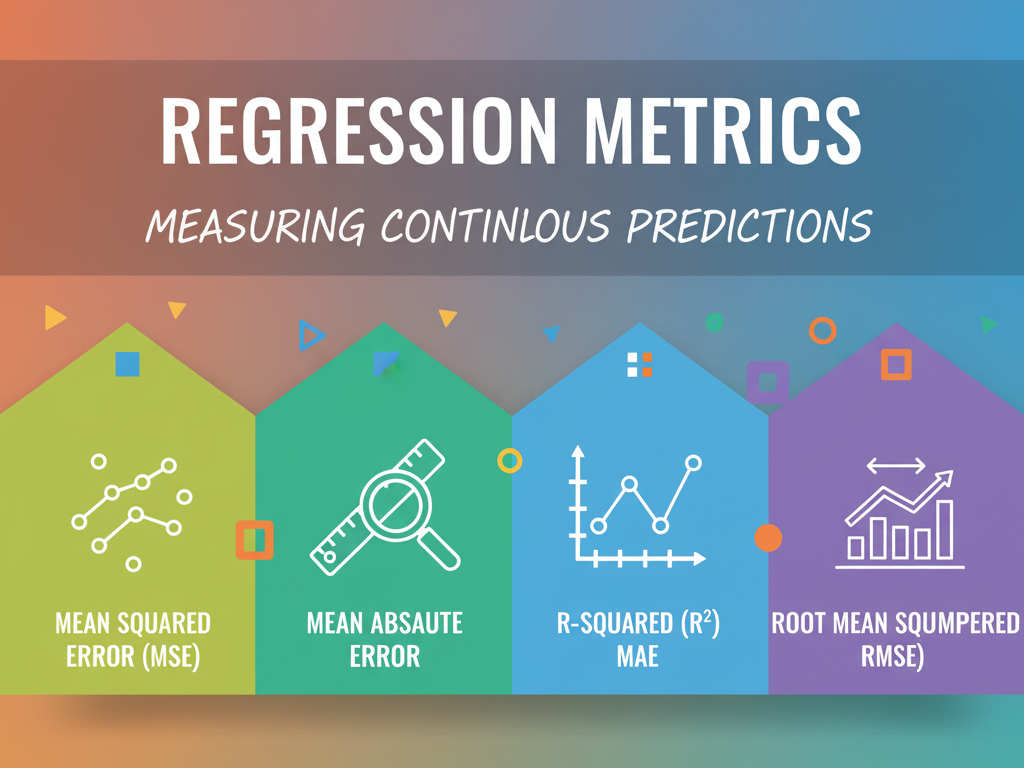
1. Mean Absolute Error (MAE): Interpretable Error Measurement
MAE = (1/n) × Σ|y_actual – y_predicted|
MAE characteristics:- Easy to interpret (average error magnitude)
- Robust to outliers
- Same units as the target variable
2. Mean Squared Error (MSE): Emphasizing Large Errors
MSE = (1/n) × Σ(y_actual – y_predicted)²
MSE characteristics:- Penalizes larger errors more severely
- Sensitive to outliers
- Harder to interpret due to squared units
3. R-squared (R²): Proportion of Variance Explained
R-squared measures how well the model explains the variance in the target variable compared to a simple mean model.
R² interpretation:- 0: Model explains none of the variance
- 1: Model explains all of the variance
- Can be negative if the model performs worse than the mean
Advanced and Specialized Metrics
1. Log Loss: Probabilistic Confidence Measurement
Logarithmic Loss evaluates not just the predictions but the confidence of those predictions, making it particularly valuable for probabilistic models.
Key applications:- Probability estimation problems
- When confidence matters as much as prediction
- Multi-class classification
2. Mean Average Precision (mAP): Object Detection Standard
mAP has become the gold standard for evaluating object detection models in computer vision, combining precision and recall across multiple thresholds.
3. BLEU Score: Natural Language Processing
The Bilingual Evaluation Understudy (BLEU) score evaluates the quality of machine-translated text by comparing it to human translations.
4. Silhouette Score: Clustering Evaluation
For unsupervised learning, the Silhouette Score measures how similar objects are to their own cluster compared to other clusters, ranging from -1 to 1.
Practical Selection Framework: Choosing the Right Metric
Business Context First Approach
Step 1: Define Business Objectives
- What constitutes success for this project?
- What are the costs of different types of errors?
- What decision will this model inform?
Step 2: Map Objectives to Metrics
| Business Context | Primary Metrics | Secondary Metrics |
| Medical Diagnosis | Recall, ROC-AUC | Precision, F1-Score |
| Spam Detection | Precision, F1-Score | Recall, ROC-AUC |
| Stock Price Prediction | MAE, RMSE | R-squared |
| Customer Churn | Precision, F1-Score | Recall, AUC |
| Recommendation System | Precision@K, NDCG | Recall, MAP |
Step 3: Consider Dataset Characteristics
- Class distribution: Use precision-recall curves for imbalanced data
- Dataset size: Simpler metrics for smaller datasets
- Noise level: Robust metrics like MAE for noisy data
Common Pitfalls and Best Practices
1. The Multiple Comparison Problem
Testing multiple models against the same test set increases the chance of finding a seemingly good model by random chance. Solution: Use cross-validation and holdout sets properly.
2. Metric Gaming
Optimizing for a single metric can lead to models that perform well on that metric but poorly in practice. Solution: Use multiple complementary metrics.
3. Ignoring Confidence Intervals
Point estimates of metrics can be misleading. Solution: Report confidence intervals or use statistical tests to compare models.
4. Overlooking Computational Costs
Some metrics require significant computation. Solution: Balance comprehensiveness with practical constraints.
Implementation Example: Python Code Snippet
from sklearn.metrics import accuracy_score, precision_score, recall_score, f1_score
from sklearn.metrics import roc_auc_score, mean_absolute_error, mean_squared_error

def comprehensive_evaluation(y_true, y_pred, y_proba=None):
    metrics = {
        'Accuracy': accuracy_score(y_true, y_pred),
        'Precision': precision_score(y_true, y_pred),
        'Recall': recall_score(y_true, y_pred),
        'F1-Score': f1_score(y_true, y_pred)
    }

    if y_proba is not None:
        metrics['ROC-AUC'] = roc_auc_score(y_true, y_proba)

    return metrics

# For regression tasks
def regression_metrics(y_true, y_pred):
    return {
        'MAE': mean_absolute_error(y_true, y_pred),
        'MSE': mean_squared_error(y_true, y_pred),
        'RMSE': np.sqrt(mean_squared_error(y_true, y_pred))
    }
Future Trends in Model Evaluation
1. Business-Aligned MetricsIncreasing focus on metrics that directly map to business KPIs rather than purely statistical measures.
2. Fairness and Bias MetricsGrowing importance of metrics that evaluate model fairness across different demographic groups.
3. Explainability MetricsNew metrics that quantify how interpretable and explainable model predictions are to human users.
4. End-to-End EvaluationHolistic evaluation frameworks that consider the entire ML pipeline rather than just model predictions.
Conclusion: Strategic Metric Selection
Selecting the right machine learning evaluation metrics requires balancing statistical rigor with practical business considerations. The most sophisticated model is worthless if it’s optimized for the wrong objective. By understanding the strengths, limitations, and appropriate applications of different metrics, you can make informed decisions that align technical performance with real-world impact.
Key takeaways:- Always start with business objectives when selecting metrics
- Use multiple complementary metrics for comprehensive evaluation
- Consider dataset characteristics and potential biases
- Validate metric choices through cross-validation and statistical testing
- Remember that no single metric tells the complete story
The field of machine learning evaluation continues to evolve, with new metrics emerging to address the challenges of modern AI applications. Staying current with these developments while maintaining a solid foundation in fundamental metrics will ensure your models deliver genuine value in production environments.
Check out other blog: How AI Is Revolutionizing Weather Forecasting in 2025