Google Beam 3D video communication: That Changes Everything
For decades, video calls have been a staple of remote work, yet they remain fundamentally two-dimensional. The experience often feels flat, lacks genuine eye contact, and fosters digital fatigue. Google Beam 3D video communication changes this entirely. This technology is a revolutionary platform that uses advanced Artificial Intelligence (AI) to create hyper-realistic, three-dimensional video calls. It offers a unique sense of presence without the need for cumbersome headsets or glasses.
- Google Beam 3D video communication moves beyond simple pixels.
- It transmits a volumetric, life-size representation of the person you are talking to.
- This achievement dramatically reduces the cognitive load of remote interaction.
The system is no longer a concept. It is now being commercially deployed to global enterprises and partners. The shift from standard video to Google Beam 3D video communication marks a critical inflection point. It is redefining professional enterprise collaboration and human connection across distances.
What is Google Beam and Why is it Revolutionary?
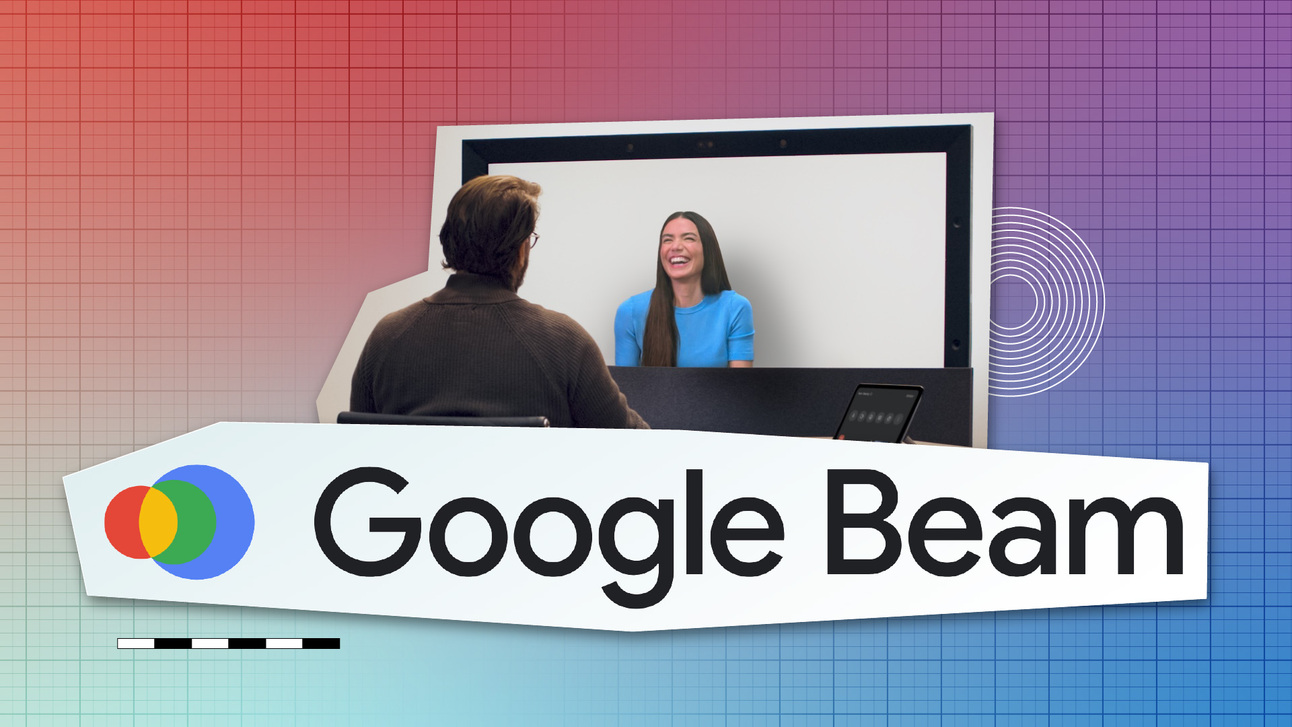
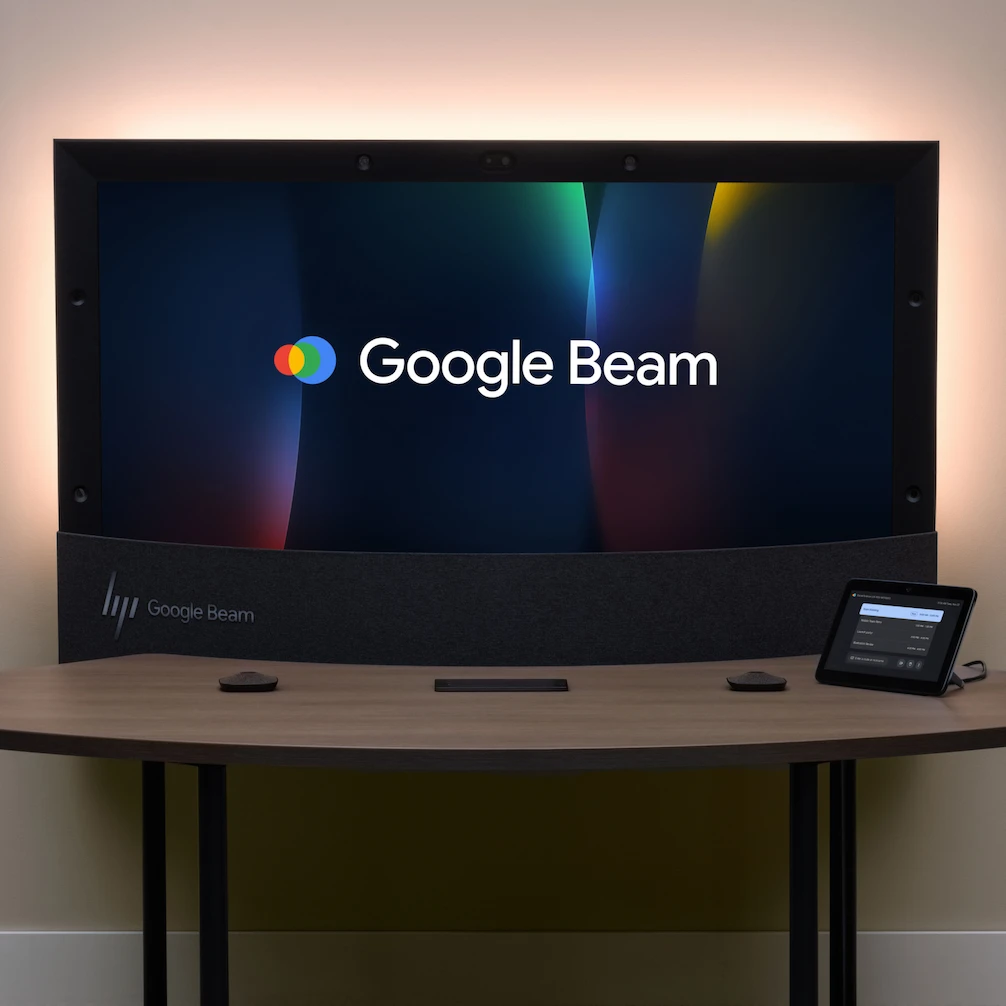
Google Beam is an AI-powered, real-time 3D video conferencing system that uses specialized hardware to project a life-size, three-dimensional image of the person you are communicating with. The system creates a virtual “magic window” that makes remote participants feel like they are truly present in the room. This makes conversations feel natural, enabling genuine eye contact and reading subtle body language.
From Project Starline to Commercial Reality
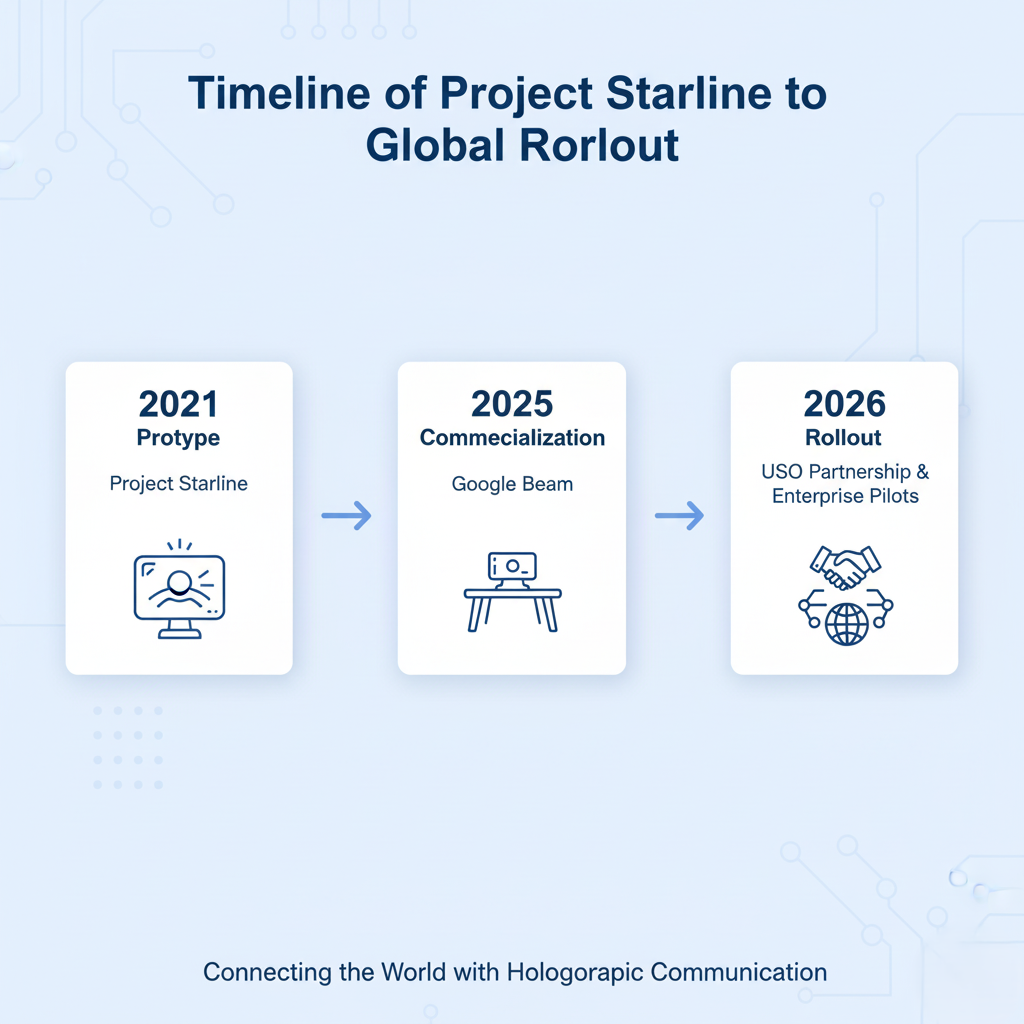
The Google Beam 3D video communication platform originated as “Project Starline.” Google first unveiled the prototype in 2021. After years of refinement, miniaturization, and optimization, it transitioned to its commercial name, Google Beam. This shift signifies its readiness for widespread enterprise adoption. The technological journey from a large laboratory prototype to an office-ready unit, supported by partners like HP, highlights a major step toward commercializing cutting-edge AI.
The Problem with Traditional Video Conferencing
Traditional video conferencing inherently destroys the sense of presence. People struggle to maintain natural eye contact. Furthermore, the lack of depth cues makes interpreting non-verbal communication difficult. This leads to what is commonly called “Zoom fatigue.” Google Beam 3D video communication solves this by recreating the parallax and depth necessary for natural, human perception, thus reducing digital exhaustion.
How Does the Google Beam 3D video communication Technology Work?
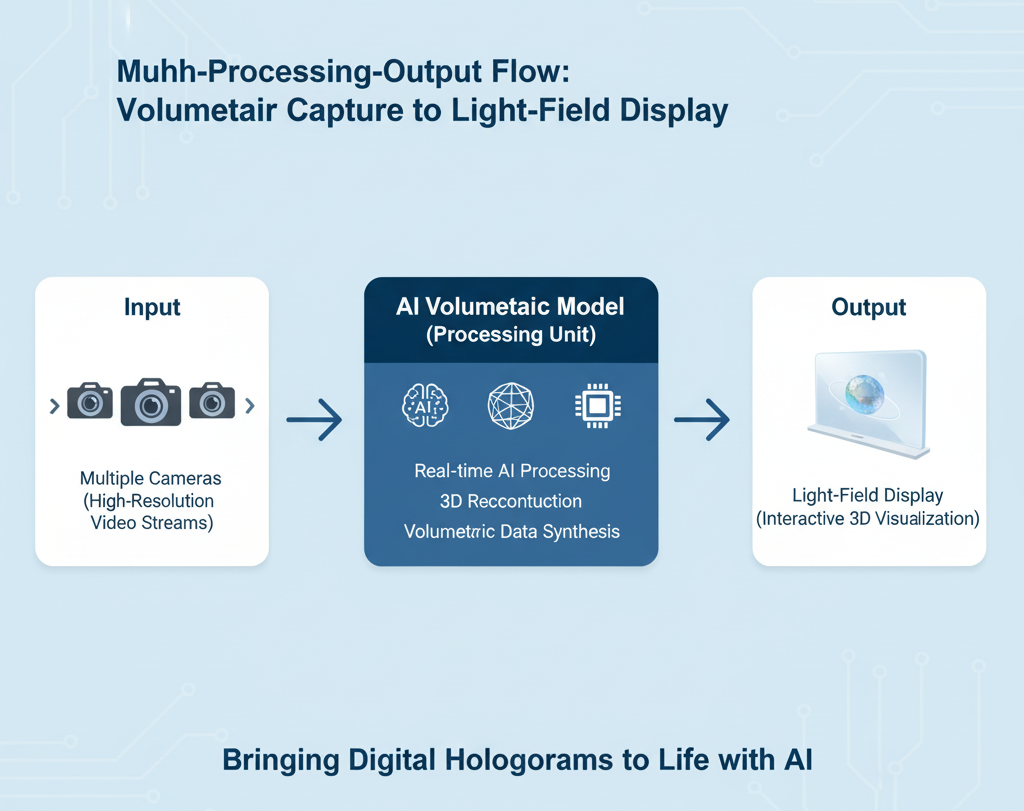
Google Beam 3D video communication achieves its realism by fusing advanced sensing hardware with proprietary AI software. It relies on a three-part system: capture, processing, and display. This is the core technical differentiator from any other video platform on the market.
The Power of the AI Volumetric Video Model
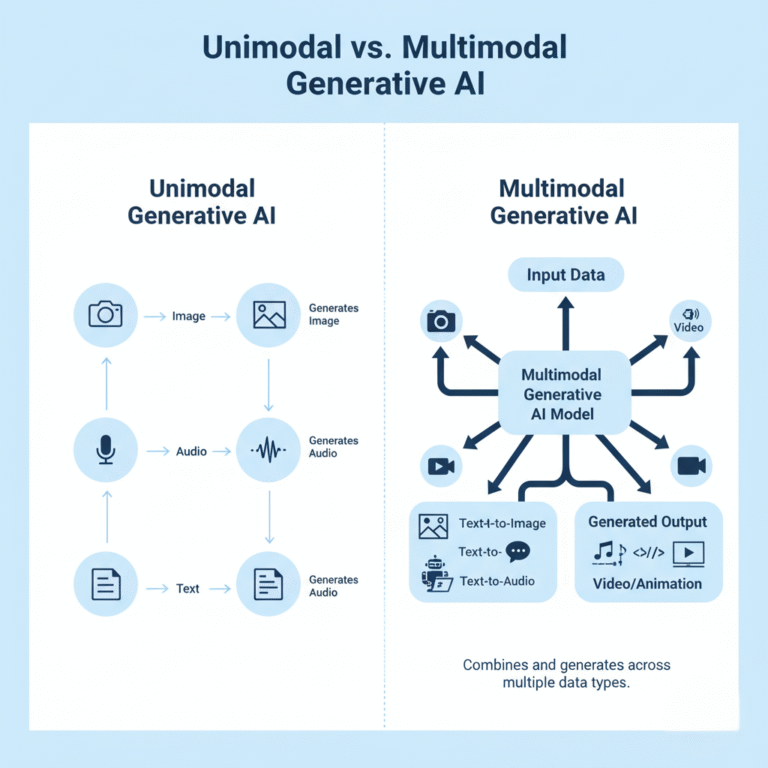
The heart of the system is the AI volumetric video model. This sophisticated generative AI model takes multiple 2D camera feeds and stitches them together in real-time holographic rendering. It does not simply create a flat image.
- The model generates a dynamic, digital 3D mesh of the remote user.
- It predicts and fills in data, especially for parts obscured from specific cameras.
- This process happens instantly, correcting for head movement and light changes.
This AI volumetric video model is what allows the remote person to appear solid and present, not flat. This high-speed, real-time AI generation is crucial for maintaining the immersion factor of the Google Beam 3D video communication experience.
Understanding the Light-Field Display
The realistic 3D effect is delivered by a proprietary light-field display. Unlike standard 3D screens that require glasses or goggles, a light-field display projects different light rays in different directions.
This means that as the viewer moves their head, the display projects the correct perspective to each eye and viewing angle. This creates a convincing, glasses-free 3D illusion with accurate depth perception. The combination of the AI volumetric video model and the light-field display is the secret sauce behind the unprecedented realism of Google Beam 3D video communication.
The Hardware Foundation: HP Dimension and the Camera Array
The software powering Google Beam 3D video communication requires specialized, high-performance hardware. Google has partnered with HP for the commercial deployment of the physical station.
Specialized Optics: The Six-Camera Setup
The capture side of the system uses a sophisticated array of sensors, typically including a six-camera array. This array is positioned around the display. It captures the user from multiple perspectives simultaneously.
- The multiple viewpoints provide the necessary data for the AI volumetric video model to construct a complete 3D representation.
- The system also incorporates depth-sensing technology.
- This enables accurate measurement of distances, which is vital for the real-time holographic rendering effect.
The complexity of the camera and sensor array ensures that the generated 3D model is highly accurate. This is the foundation of the seamless Google Beam 3D video communication experience.
The Cost of Immersion: HP’s Enterprise Focus
The dedicated hardware, known as HP Dimension, is designed for high-end enterprise collaboration. It is not a consumer product. The specialized components, including the custom camera array, powerful processing unit, and the high-resolution light-field display, translate to a significant investment.
Real-World Adoption: Enterprise Collaboration and Key Partnerships
Google Beam 3D video communication is moving beyond testing and into practical use. Its initial deployment focuses on scenarios where genuine human connection and presence are critically important.
Case Study: The USO Partnership for Military Families
In a deeply impactful use case, Google announced a partnership with the United Service Organizations (USO). This pilot program aims to install Google Beam 3D video communication stations at USO centers globally.
- This initiative allows deployed military service members to connect with their families.
- The 3D presence enables them to feel closer, such as reading a bedtime story or attending a birthday.
- This demonstrates the platform’s ability to bridge emotional distance, which is a key value proposition of the technology. The USO partnership proves the profound human utility of this advanced technology.
Commercial Deployment: HP, Salesforce, and Deloitte
Beyond the military, the system is being tested by major global companies focused on enhancing high-stakes enterprise collaboration.
- Partners like Salesforce and Deloitte are pioneering the use of Google Beam 3D video communication for executive meetings and critical client interactions.
- The ability to perceive subtle non-verbal cues is invaluable in contract negotiations or complex problem-solving sessions.
- This adoption confirms that the technology is seen as a key investment for the future of high-value remote work.
The technology’s ability to support real-time holographic rendering is transforming sectors reliant on visual, complex communication. Professionals seeking to understand the power of modern AI can refer to our detailed guides, such as .
Technical Deep Dive: Rendering, Latency, and Real-Time Holographic Rendering
Maintaining realism in Google Beam 3D video communication requires overcoming immense technical hurdles related to data throughput and processing speed.
Data Compression and Bandwidth Challenges
A full 3D video feed, rendered at high resolution, generates enormous amounts of data. Sending this instantly across a standard internet connection is nearly impossible.
- The AI volumetric video model is not just for rendering; it also performs extreme, AI-driven compression.
- The model analyzes the data for redundancies and only transmits the necessary volumetric changes.
- This ensures that the real-time holographic rendering remains fluid and low-latency, even over standard enterprise networks.
Furthermore, this necessitates the AI to work flawlessly on the server side and the edge-computing unit within the HP Dimension hardware itself. This dual processing is a technical marvel of Google Beam 3D video communication.
The Role of Edge Computing
The processing must occur fast enough to minimize latency. If the delay between gesture and visual projection exceeds about 100 milliseconds, the illusion of presence is broken. Therefore, much of the AI processing—including the real-time holographic rendering—is done locally on the dedicated hardware (Edge Computing). This removes the reliance on cloud server round-trips for core functions. Understanding this distributed processing model is key to appreciating the technology’s performance.
The Future Impact of Google Beam 3D video communication
The introduction of Google Beam 3D video communication is not an incremental update to video calling. It is a foundational change with vast implications for the future of work and interaction.
The applications span numerous high-value sectors:
- Healthcare: Remote consultations could allow doctors to perceive subtle changes in a patient’s breathing or posture with greater fidelity.
- Education: Professors could conduct virtual laboratory sessions where students see 3D models of molecules or artifacts projected realistically.
- Remote Work: It fosters greater team cohesion and reduces the feeling of isolation, supporting complex, long-duration enterprise collaboration.
The shift requires new ways of thinking about digital presence, which is a concept we explore in our resources on and the broader AI ecosystem.
Ethical Considerations: Presence and Privacy
The realism of Google Beam 3D video communication raises ethical questions. The AI volumetric video model captures and processes highly detailed 3D data of individuals.
- Privacy protocols must be exceptionally robust to handle this level of biometric data.
- Furthermore, the high fidelity creates potential for misuse (e.g., creating convincing deepfakes or unauthorized real-time holographic rendering).
The commitment of companies like Google, HP, and the partners must ensure responsible deployment. Professionals in this space must prioritize ethical AI practices, which is a focus of our . For the latest developments on responsible AI deployment, we recommend reading publications from Google Beam
FAQ: Getting Started with Google Beam
Q: Is Google Beam the same as Project Starline?
A: Yes. Google Beam is the commercial name for the technology originally developed under the codename Project Starline. It represents the fully realized, office-ready version of the platform.
Q: Do I need special glasses to use Google Beam 3D video communication?
A: No. A key feature of the Google Beam 3D video communication system is its specialized light-field display, which provides a convincing, glasses-free 3D experience.
Q: Who is the primary customer for this technology?
A: The primary customer is large-scale enterprise collaboration and professional organizations (e.g., military, healthcare, consulting firms) that require high-fidelity, high-presence communication. The hardware, manufactured by $\text{(nofollow)}$, is designed for professional deployment.
Q: What is the benefit of the AI volumetric video model?
A: The AI volumetric video model generates a real-time 3D reconstruction of the person, which is necessary to project the realistic depth and perspective onto the light-field screen. It turns 2D inputs into a 3D presence. The technology is driving efficiency, which you can track using our . We also encourage reviewing the work of critical technology partners like the $\text{(nofollow)}$ to understand the platform’s social impact.
Google Beam is more than just a camera and a screen. It is a fusion of advanced AI, optics, and display technology resulting in the first truly unprecedented form of remote human connection.