

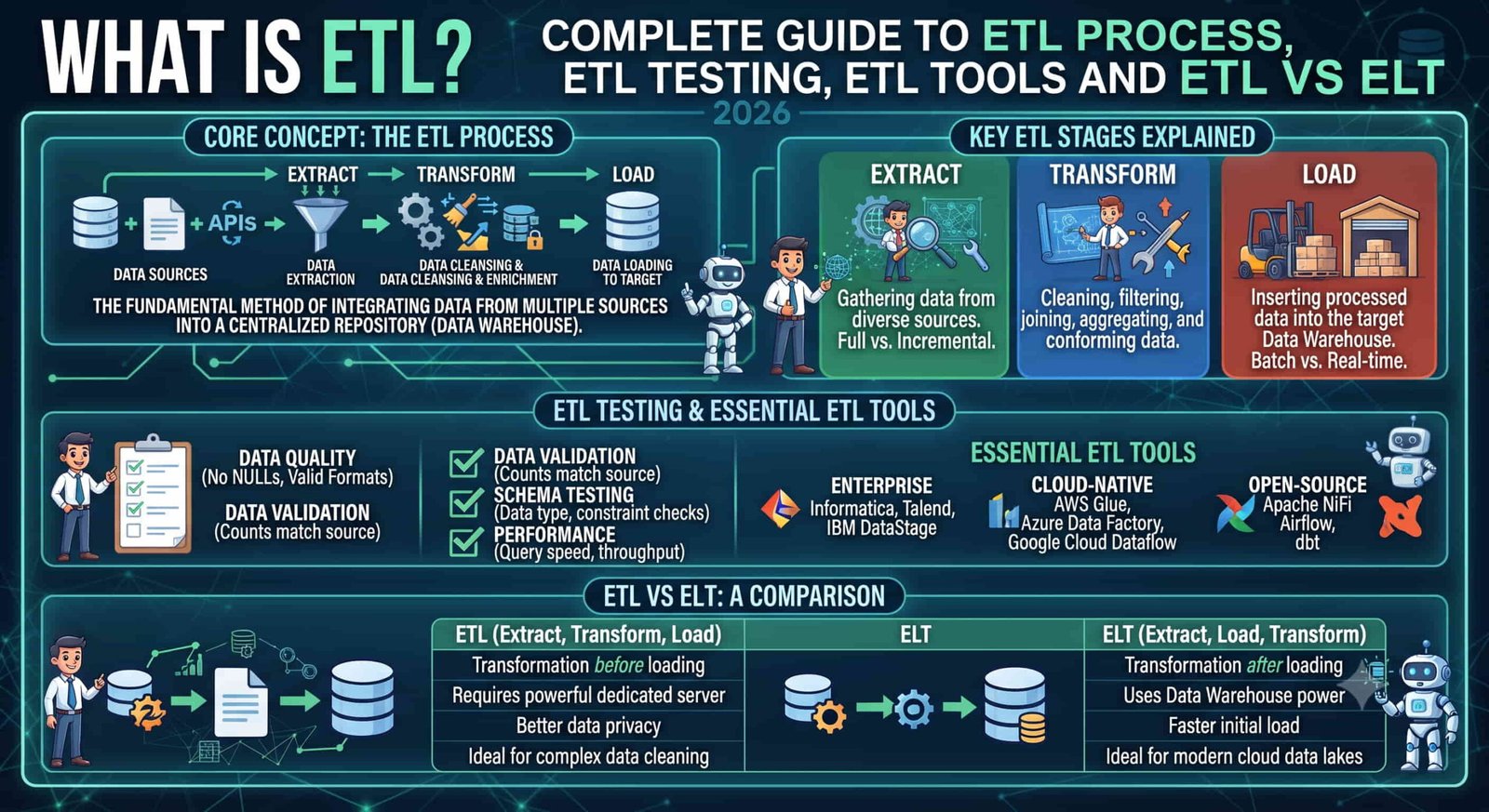
What Is ETL? Complete Guide to Extract, Transform, and Load
Data is often called the new oil of the digital economy. However, raw data by itself has little value unless it can be collected, cleaned, organized, and transformed into useful information. Organizations generate data from websites, mobile applications, databases, IoT devices, cloud services, social media platforms, and enterprise systems every second. Before this data can support business intelligence, analytics, reporting, or artificial intelligence, it must go through a structured process known as ETL.
ETL is one of the most important concepts in Data Engineering and Data Warehousing. It serves as the backbone of modern analytics platforms by ensuring that data is accurate, consistent, and readily available for decision-making.
In this comprehensive guide, you’ll learn what ETL is, how it works, why it matters, the tools used in ETL, ETL testing, ETL architecture, ETL vs ELT comparisons, and real-world applications.
What Does ETL Stand For?
ETL stands for:
-
Extract
-
Transform
-
Load
These three stages define the process of collecting data from one or more sources, converting it into a usable format, and storing it in a target system for analysis and reporting.
The ETL process ensures that businesses can combine information from multiple systems and create a single source of truth.
What Is ETL in Simple Words?
Imagine you are preparing a meal.
Extract
You gather ingredients from different stores.
Transform
You wash, cut, and cook the ingredients.
Load
You serve the finished meal on a plate.
ETL works similarly.
Extract
Collect raw data from various sources.
Transform
Clean, validate, and organize the data.
Load
Store the processed data in a data warehouse or analytics system.
The final result is clean, reliable, and analytics-ready data.
Why Is ETL Important?
Modern organizations depend on data-driven decision-making. ETL makes this possible by ensuring data quality and accessibility.
ETL helps organizations:
-
Integrate data from multiple systems
-
Improve data quality
-
Eliminate duplicates
-
Standardize formats
-
Support business intelligence
-
Enable machine learning
-
Power dashboards and reports
-
Ensure regulatory compliance
-
Improve operational efficiency
Without ETL, organizations would spend significant time manually cleaning and preparing data.
How ETL Works
The ETL process consists of three major stages.
Stage 1: Extract
Extraction is the process of collecting data from source systems.
Common data sources include:
-
Relational databases
-
NoSQL databases
-
APIs
-
CRM systems
-
ERP systems
-
Cloud applications
-
CSV files
-
Excel files
-
IoT devices
-
Social media platforms
Example:
Sales Database
Customer Database
Marketing Platform
Website Analytics
        ↓
      Extract
The goal is to retrieve the required data while minimizing impact on operational systems.
Types of Data Extraction
Full Extraction
All data is extracted every time.
Best for:
-
Small datasets
-
Initial data loads
Incremental Extraction
Only newly added or modified records are extracted.
Best for:
-
Large datasets
-
Production environments
Stage 2: Transform
Transformation is often the most complex stage of ETL.
Raw data is converted into a consistent and usable format.
Common Transformations
Data Cleaning
Correcting errors and inconsistencies.
Example:
Hydrabad → Hyderabad
Removing Duplicates
Duplicate Records
      ↓
Unique Records
Data Standardization
Converting values into a common format.
Example:
01-01-2026
2026/01/01
Jan 1, 2026

      ↓

2026-01-01
Data Validation
Checking for:
-
Missing values
-
Invalid entries
-
Incorrect formats
Aggregation
Combining detailed data into summaries.
Example:
Daily Sales
      ↓
Monthly Sales
Business Rule Implementation
Example:
Profit = Revenue - Expenses
Data Enrichment
Adding additional information from external sources.
Stage 3: Load
Loading transfers transformed data into a destination system.
Common targets include:
-
Data Warehouses
-
Data Lakes
-
Data Marts
-
Analytics Platforms
Popular destinations:
-
Snowflake
-
Amazon Redshift
-
Google BigQuery
-
Azure Synapse Analytics
-
Databricks
Example:
Clean Data
    ↓
Data Warehouse
Once loaded, the data becomes available for reporting, analytics, and machine learning.
ETL Architecture
A typical ETL architecture consists of several layers.
Source Systems
       ↓
Extraction Layer
       ↓
Staging Area
       ↓
Transformation Layer
       ↓
Loading Layer
       ↓
Data Warehouse
       ↓
Analytics & BI
Each layer serves a specific purpose and ensures reliable data movement.
ETL in Data Engineering
Data Engineering focuses on designing and maintaining data infrastructure.
ETL is a core responsibility of Data Engineers.
Data Engineers use ETL to:
-
Build data pipelines
-
Integrate systems
-
Process large datasets
-
Improve data quality
-
Support analytics teams
-
Enable machine learning workflows
Without ETL, modern data platforms cannot function effectively.
ETL in Data Warehousing
A Data Warehouse serves as a centralized repository for analytical data.
ETL acts as the bridge between operational systems and the warehouse.
Example:
CRM
ERP
Finance System
Website Data
      ↓
      ETL
      ↓
Data Warehouse
      ↓
Business Intelligence
ETL ensures that only clean and structured data reaches the warehouse.
ETL in SQL
SQL is widely used throughout ETL processes.
Filtering Data
SELECT *
FROM customers
WHERE country = 'India';
Aggregating Data
SELECT SUM(sales)
FROM orders;
Joining Tables
SELECT *
FROM customers c
JOIN orders o
ON c.customer_id = o.customer_id;
Creating Derived Columns
SELECT
quantity * price AS revenue
FROM sales;
SQL remains one of the most important skills for ETL developers and Data Engineers.
ETL Testing
ETL Testing ensures that data is transferred accurately from source to destination.
The objective is to identify issues before they impact business reporting.
Goals of ETL Testing
-
Verify data accuracy
-
Validate transformations
-
Check data completeness
-
Detect duplicates
-
Confirm business rules
-
Measure performance
Types of ETL Testing
Source-to-Target Testing
Verifies data consistency.
Data Completeness Testing
Ensures no records are missing.
Data Quality Testing
Checks for invalid or incorrect values.
Performance Testing
Measures execution speed and scalability.
Regression Testing
Validates changes after updates.
ETL Tools
Organizations use ETL tools to automate data integration.
Enterprise ETL Tools
-
Informatica PowerCenter
-
IBM DataStage
-
Oracle Data Integrator
-
Microsoft SSIS
-
Talend
Modern Cloud ETL Tools
-
Fivetran
-
Airbyte
-
Matillion
-
Hevo Data
-
Stitch
Open-Source ETL Tools
-
Apache NiFi
-
Pentaho
-
Talend Open Studio
-
Airbyte Community Edition
Big Data ETL Tools
-
Apache Spark
-
Databricks
-
AWS Glue
-
Apache Beam
ETL vs ELT
As cloud computing evolved, a new approach called ELT became popular.
What Is ELT?
ELT stands for:
-
Extract
-
Load
-
Transform
Instead of transforming data before loading, ELT loads raw data first and transforms it later inside the data warehouse.
Difference Between ETL and ELT
| Feature | ETL | ELT |
|---|---|---|
| Transformation | Before Loading | After Loading |
| Processing Location | ETL Server | Data Warehouse |
| Scalability | Moderate | High |
| Cloud Compatibility | Good | Excellent |
| Speed | Slower | Faster |
| Big Data Support | Limited | Strong |
ETL vs ELT Example
ETL Example
Customer Data
      ↓
Transform
      ↓
Clean Data
      ↓
Snowflake
ELT Example
Customer Data
      ↓
Snowflake
      ↓
Transform Using SQL
      ↓
Analytics
Modern cloud platforms generally favor ELT due to their scalable compute capabilities.
Real-World Applications of ETL
Banking
-
Fraud detection
-
Transaction reporting
-
Risk analysis
Healthcare
-
Patient records integration
-
Medical analytics
-
Regulatory reporting
E-Commerce
-
Customer behavior analysis
-
Product recommendations
-
Sales reporting
Manufacturing
-
Supply chain analytics
-
Production monitoring
Telecommunications
-
Network performance monitoring
-
Customer analytics
ETL Best Practices
To build reliable ETL systems:
Use Incremental Loads
Reduce processing time.
Implement Data Validation
Ensure data quality.
Monitor Pipeline Performance
Detect failures quickly.
Automate Testing
Improve reliability.
Maintain Documentation
Support scalability and maintenance.
Optimize SQL Queries
Improve performance.
Secure Sensitive Data
Ensure compliance with regulations.
Future of ETL
The future of ETL is being shaped by:
-
AI-Powered Data Pipelines
-
Real-Time Data Processing
-
Streaming ETL
-
Data Observability
-
Data Mesh Architectures
-
Lakehouse Platforms
-
Agentic Data Engineering
-
Automated Data Quality Monitoring
As organizations generate increasingly large volumes of data, ETL will continue to play a critical role in enabling analytics, machine learning, and business intelligence.
Conclusion
ETL (Extract, Transform, Load) is one of the foundational concepts in Data Engineering and Data Warehousing. It enables organizations to collect data from multiple sources, improve its quality, and make it available for analytics and decision-making. Whether you are a student, Data Analyst, Data Engineer, Data Scientist, or business professional, understanding ETL is essential for working with modern data systems.
As cloud computing, AI, and big data technologies continue to evolve, ETL remains a critical skill and a core component of every data-driven organization.