

What Is Data Science? A Complete Beginner’s Guide (2026)
Introduction
Data Science is one of the fastest-growing fields in the world, powering innovations in artificial intelligence, machine learning, business intelligence, healthcare, finance, e-commerce, and countless other industries. Organizations generate enormous amounts of data every day, and Data Science helps transform that raw information into valuable insights, predictions, and decisions.
Whether you are a student exploring career options, a working professional looking to switch careers, or a business owner interested in data-driven decision-making, understanding Data Science is becoming increasingly important.
In this guide: You will learn what Data Science is, how it works, the essential skills required, career opportunities, salaries, tools, and how to get started on your journey.
What Is Data Science?
Data Science is an interdisciplinary field that combines statistics, mathematics, programming, data analysis, and domain knowledge to extract meaningful insights from data.
In simple terms, Data Science is the process of collecting, cleaning, analyzing, and interpreting data to solve complex problems and make better business decisions.
Companies use Data Science to:
-
Understand customer behavior and preferences
-
Predict future market trends and demands
-
Improve daily business operations and efficiency
-
Detect financial fraud within seconds
-
Optimize multi-channel marketing campaigns
-
Build intelligent AI systems and recommendation engines
-
Automate complex decision-making processes
The Official Definition
A widely accepted definition of Data Science is the study of data using scientific methods, algorithms, processes, and systems to discover knowledge, patterns, and actionable insights. Data scientists work with both structured and unstructured data sourced from databases, websites, mobile apps, social media, IoT sensors, and cloud platforms.
Why Is Data Science Important?
Modern organizations generate massive amounts of data every second through online shopping transactions, banking operations, social media interactions, healthcare records, and transportation systems. Without Data Science, this information remains unused digital noise.
Data Science enables organizations to achieve critical advantages:
| Benefit | How It Works |
| Improve Decision Making | Replace gut assumptions with evidence-backed analytics and data models. |
| Increase Revenue | Identify profitable opportunities and optimize customer acquisition. |
| Reduce Costs | Uncover internal inefficiencies and streamline operational performance. |
| Predict Future Outcomes | Forecast sales, customer churn, and macroeconomic trends using machine learning. |
| Create Intelligent Products | Power recommendation systems, chatbots, and autonomous tools. |
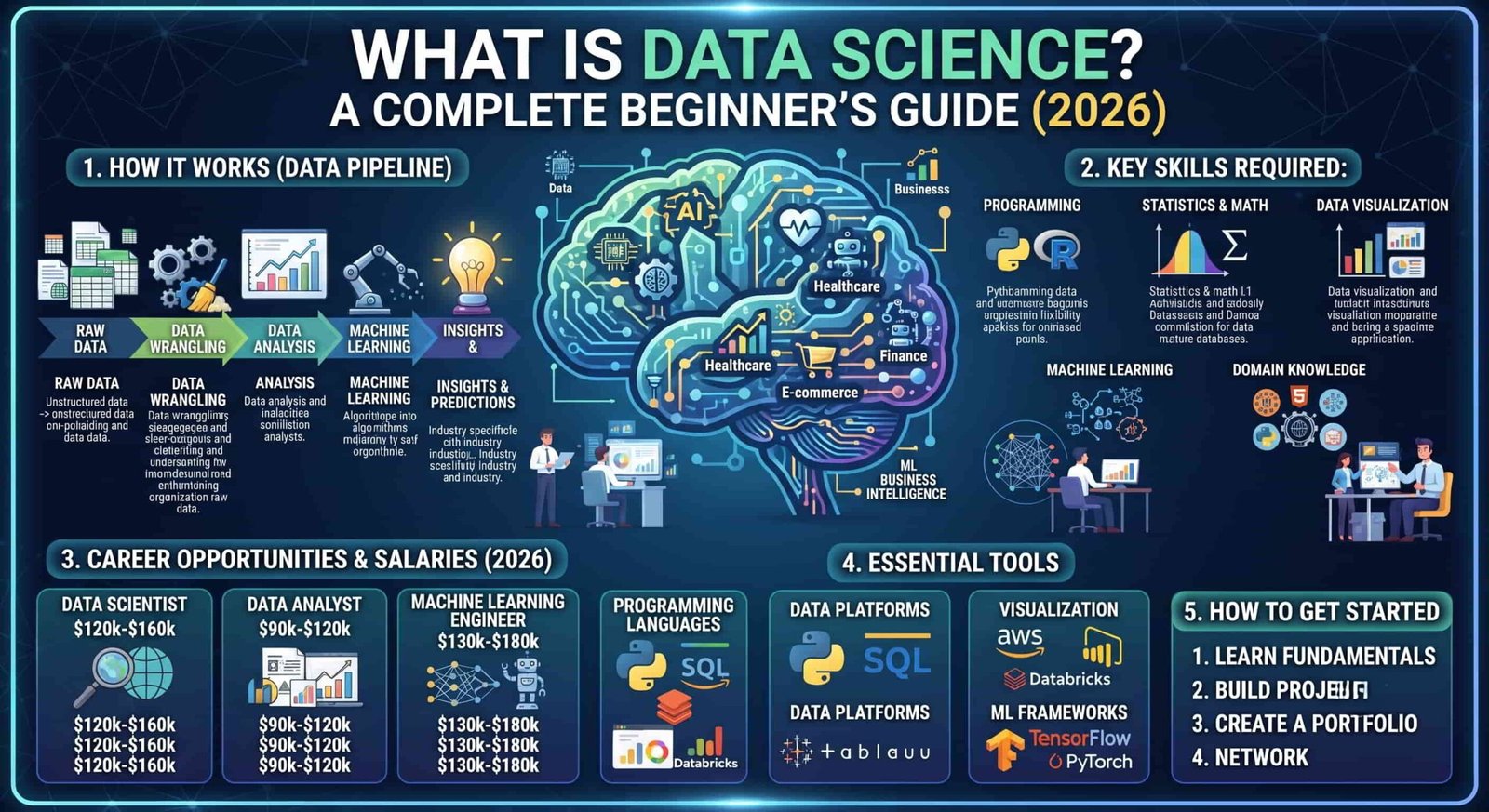
How Does Data Science Work?
A typical Data Science project follows a structured lifecycle to ensure accurate and actionable results:
-
Data Collection: Gathering information from APIs, databases, cloud storage, and web sources.
-
Data Cleaning: Fixing missing values, duplicates, and formatting errors to ensure data reliability.
-
Data Exploration: Examining datasets to uncover initial patterns, trends, and outliers.
-
Data Analysis: Applying statistical methods to answer core business questions.
-
Machine Learning: Training algorithms to make automated predictions and classifications.
-
Visualization: Presenting insights through clear charts, dashboards, and BI reports.
-
Deployment: Integrating trained models into real-world software applications and business processes.
Core Components and Comparisons
Components of Data Science
-
Statistics & Mathematics: Provide the foundational logic and probability models for algorithms.
-
Programming: Languages like Python, R, and SQL are used to manipulate and process data.
-
Data Engineering: Focuses on building and managing reliable data infrastructure.
-
Machine Learning: Enables computers to learn from historical data and make automated predictions.
-
Data Visualization: Transforms complex numbers into digestible visual formats for stakeholders.
Data Science vs. Artificial Intelligence vs. Machine Learning
| Field | Primary Focus | Core Mechanism |
| Data Science | Extracting insights from data | Statistical analysis and business intelligence |
| Artificial Intelligence | Creating intelligent systems | Advanced automation and cognitive learning |
| Machine Learning | Model training and predictions | Subset of Data Science focused on algorithmic learning |
Essential Skills and Tools
To become a successful data professional, you should build proficiency across several technical and interpersonal areas:
-
Programming: Python, SQL, R
-
Math & Stats: Linear algebra, probability, hypothesis testing
-
Data Analysis: Pandas, NumPy, Excel
-
Data Visualization: Power BI, Tableau, Matplotlib
-
Machine Learning: Scikit-Learn, TensorFlow, PyTorch
-
Cloud Platforms: AWS, Microsoft Azure, Google Cloud Platform
-
Communication: Explaining technical findings clearly to non-technical business stakeholders.
Career Opportunities and the Future
Data Science offers diverse and lucrative career paths, including roles such as Data Analyst, Data Scientist, Machine Learning Engineer, Data Engineer, and AI Engineer.
Is it a good career? Yes. Strong demand, high earning potential, remote work flexibility, and direct involvement in emerging AI technologies make Data Science one of the most attractive modern career options.
The Future of Data Science
The future of the field is deeply intertwined with Artificial Intelligence, Generative AI, agentic workflows, automation, and big data cloud computing. As organizations worldwide become increasingly data-driven, the demand for skilled professionals will continue to climb.
Conclusion
Data Science is the practice of transforming raw data into meaningful insights that drive smarter decisions. It combines programming, statistics, machine learning, and business understanding to solve real-world problems.
Whether your goal is to become a Data Scientist, transition into AI, or improve business performance, learning Data Science opens the door to exciting opportunities. The best way to start is by mastering Python, SQL, statistics, and machine learning fundamentals while building hands-on projects.