

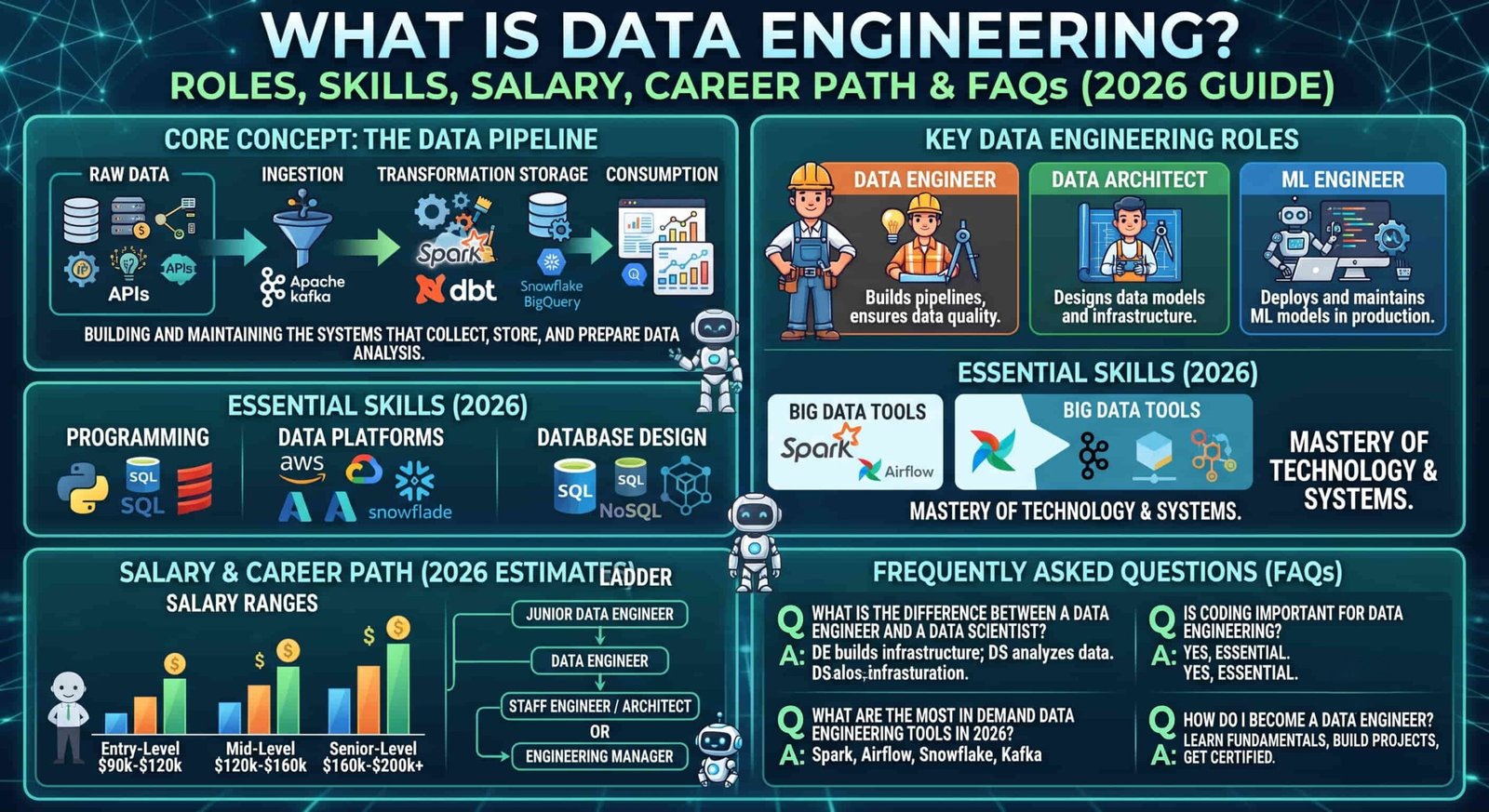
What Is Data Engineering? Roles, Skills, Salary, Career Path & FAQs (2026 Guide)
What Is Data Engineering? A Complete Beginner’s Guide
In today’s digital world, organizations generate enormous amounts of data every second. However, raw data alone has little value unless it can be collected, processed, stored, and made accessible for analysis. This is where Data Engineering comes into play.
Data Engineering is the discipline of designing, building, and maintaining systems that collect, store, transform, and distribute data for analytics, reporting, machine learning, and business intelligence.
Simply put, Data Engineers create the infrastructure that allows organizations to use data effectively.
What Is Data Engineering in Simple Words?
Imagine a city water supply system.
Before people can use water, it must be:
-
Collected
-
Filtered
-
Stored
-
Transported through pipelines
Similarly, before analysts, data scientists, or AI engineers can use data, it must be:
-
Collected from different sources
-
Cleaned and transformed
-
Stored in databases or data warehouses
-
Delivered to users and applications
A Data Engineer builds and maintains these data pipelines.
Why Is Data Engineering Important?
Modern businesses rely heavily on data-driven decisions. Data Engineering helps organizations:
-
Improve decision-making
-
Enable business intelligence
-
Support AI and Machine Learning initiatives
-
Process large-scale data efficiently
-
Ensure data quality and reliability
-
Build real-time analytics systems
Without Data Engineering, organizations would struggle to extract meaningful insights from their data.
What Does a Data Engineer Do?
A Data Engineer is responsible for building and managing data infrastructure.
Typical responsibilities include:
Data Collection
Gathering data from:
-
Applications
-
Websites
-
APIs
-
Databases
-
IoT devices
Data Transformation
Cleaning and preparing data using ETL/ELT processes.
Data Storage
Managing:
-
Data Warehouses
-
Data Lakes
-
Databases
Data Pipeline Development
Creating automated systems that move data between platforms.
Performance Optimization
Ensuring data systems are scalable and efficient.
Data Security
Implementing governance, privacy, and compliance controls.
Core Components of Data Engineering
Data Sources
Examples:
-
MySQL
-
PostgreSQL
-
MongoDB
-
APIs
-
CRM systems
ETL/ELT Pipelines
ETL:
-
Extract
-
Transform
-
Load
ELT:
-
Extract
-
Load
-
Transform
Data Warehouses
Popular solutions:
-
Snowflake
-
Amazon Redshift
-
Google BigQuery
-
Azure Synapse
Data Lakes
Examples:
-
Amazon S3
-
Azure Data Lake
-
Google Cloud Storage
Processing Engines
Examples:
-
Apache Spark
-
Apache Flink
-
Hadoop
Data Engineering Skills
Successful Data Engineers typically require the following skills:
Programming Languages
-
Python
-
SQL
-
Scala
-
Java
Databases
-
MySQL
-
PostgreSQL
-
SQL Server
-
MongoDB
Big Data Technologies
-
Hadoop
-
Spark
-
Kafka
-
Hive
Cloud Platforms
-
AWS
-
Azure
-
Google Cloud Platform (GCP)
Data Warehousing
-
Snowflake
-
BigQuery
-
Redshift
DevOps & Automation
-
Docker
-
Kubernetes
-
Airflow
-
Git
Data Modeling
Understanding:
-
Star Schema
-
Snowflake Schema
-
Dimensional Modeling
Data Engineering Lifecycle
A typical data engineering workflow:
-
Data Collection
-
Data Validation
-
Data Transformation
-
Data Storage
-
Data Processing
-
Data Delivery
-
Monitoring & Optimization
Popular Data Engineering Tools
Data Integration
-
Apache Airflow
-
Talend
-
Informatica
Streaming
-
Apache Kafka
-
Apache Pulsar
Data Processing
-
Apache Spark
-
Databricks
Storage
-
Snowflake
-
Redshift
-
BigQuery
Orchestration
-
Airflow
-
Prefect
-
Dagster
Career Opportunities in Data Engineering
Common job titles include:
-
Data Engineer
-
Cloud Data Engineer
-
Big Data Engineer
-
Analytics Engineer
-
Data Platform Engineer
-
ETL Developer
-
Data Architect
-
MLOps Engineer
Future of Data Engineering
As organizations increasingly adopt Artificial Intelligence, Machine Learning, and real-time analytics, demand for Data Engineers continues to grow.
Emerging trends include:
-
AI-powered data pipelines
-
Real-time data processing
-
Data Mesh architectures
-
Data Observability
-
Lakehouse platforms
-
Agentic AI integration
Conclusion
Data Engineering forms the foundation of modern data-driven organizations. Data Engineers design and maintain the infrastructure that enables analytics, reporting, and AI systems to function efficiently. With growing demand across industries, Data Engineering offers excellent career opportunities, competitive salaries, and long-term growth potential.