
What Is Agentic AI? A Complete Guide to Autonomous AI Systems
Artificial Intelligence is evolving beyond simple chatbots and predictive models. A new paradigm known as Agentic AI is transforming how machines interact with the world by enabling them to make decisions, take actions, and pursue goals with minimal human intervention.
As organizations increasingly seek automation and intelligent decision-making, Agentic AI has emerged as one of the most important trends in artificial intelligence. Recent global search trends show growing interest in Agentic AI across countries such as Singapore, India, the United States, Malaysia, and the Philippines, reflecting its rising importance in business and technology.
What Is Agentic AI?
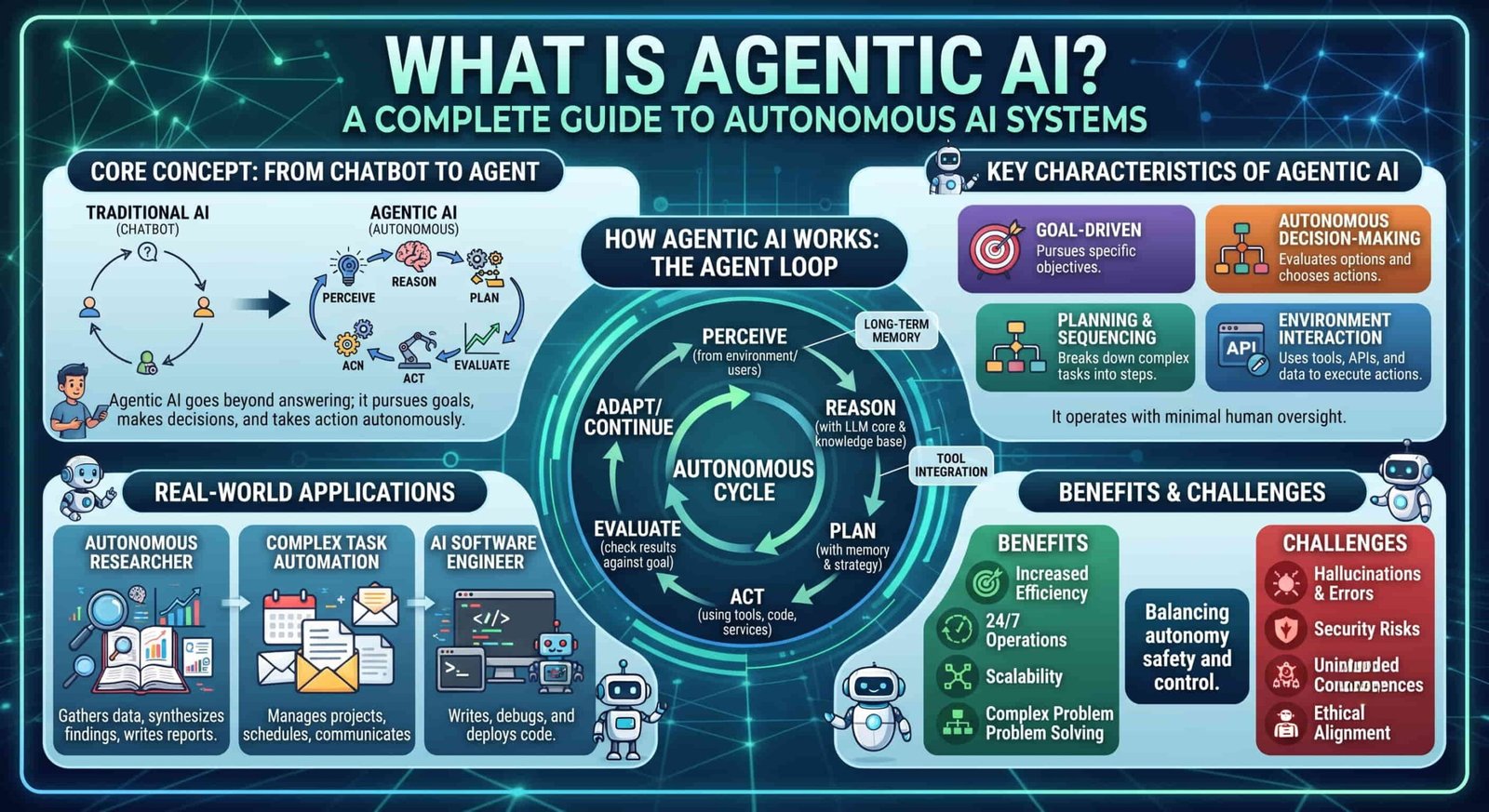
Agentic AI refers to AI systems that can autonomously perceive their environment, reason about objectives, plan actions, execute tasks, and adapt based on outcomes to achieve specific goals.
Unlike traditional AI systems that respond only when prompted, Agentic AI acts more like an intelligent agent capable of:
-
Understanding objectives
-
Creating plans
-
Making decisions
-
Executing actions
-
Learning from feedback
-
Adjusting strategies dynamically
In simple terms, Agentic AI moves from merely answering questions to accomplishing objectives.
How Agentic AI Differs from Traditional AI
| Traditional AI | Agentic AI |
|---|---|
| Responds to prompts | Pursues goals autonomously |
| Limited decision-making | Multi-step reasoning |
| Reactive behavior | Proactive behavior |
| Human-driven workflows | Semi-autonomous workflows |
| Single-task focus | Complex task orchestration |
For example:
Traditional AI
A chatbot answers customer questions when asked.
Agentic AI
An AI agent can:
-
Receive a customer complaint
-
Analyze the issue
-
Check order history
-
Generate a solution
-
Create a support ticket
-
Follow up with the customer
All with minimal human involvement.
Core Components of Agentic AI
1. Goal Understanding
The AI must understand what outcome needs to be achieved.
Example:
Increase website traffic by 20% in three months.
2. Planning
The system breaks large objectives into smaller actionable tasks.
Example:
-
Analyze traffic data
-
Identify content gaps
-
Generate content ideas
-
Publish articles
-
Monitor results
3. Reasoning
The agent evaluates different approaches and chooses the most effective strategy.
4. Memory
Agentic systems store and retrieve information from previous interactions.
Memory enables:
-
Context retention
-
Personalization
-
Continuous improvement
5. Action Execution
The AI can interact with tools, APIs, databases, software platforms, and digital environments.
Examples include:
-
Sending emails
-
Updating CRM systems
-
Creating reports
-
Executing workflows
6. Feedback and Adaptation
Agentic AI continuously learns from outcomes and adjusts future decisions.
How Agentic AI Works
A typical Agentic AI workflow follows these steps:
Step 1: Receive Objective
The user provides a goal.
Example:
Create a marketing campaign for a new product launch.
Step 2: Analyze Requirements
The AI gathers information and identifies constraints.
Step 3: Generate a Plan
The system creates a sequence of actions needed to achieve the goal.
Step 4: Execute Tasks
The AI performs actions using available tools.
Step 5: Evaluate Results
The agent measures outcomes against objectives.
Step 6: Improve Strategy
The AI modifies its approach based on performance data.
Real-World Applications of Agentic AI
Customer Support
AI agents can:
-
Resolve tickets
-
Escalate complex cases
-
Follow up with customers
-
Update support systems
Software Development
Agentic AI can:
-
Generate code
-
Test applications
-
Detect bugs
-
Deploy updates
Marketing Automation
AI agents can:
-
Conduct keyword research
-
Generate content
-
Schedule campaigns
-
Analyze performance metrics
Healthcare
Applications include:
-
Patient scheduling
-
Medical documentation
-
Clinical decision support
-
Healthcare workflow optimization
Finance
Agentic AI can assist with:
-
Risk analysis
-
Fraud detection
-
Portfolio monitoring
-
Financial reporting
Supply Chain Management
Capabilities include:
-
Demand forecasting
-
Inventory optimization
-
Route planning
-
Logistics coordination
Benefits of Agentic AI
Increased Productivity
Organizations can automate complex workflows that previously required significant human effort.
Faster Decision-Making
AI agents process large amounts of information rapidly and make informed decisions.
Reduced Operational Costs
Automation decreases repetitive manual work and improves efficiency.
Improved Scalability
Businesses can handle larger workloads without proportionally increasing staffing.
Continuous Operation
AI agents can work around the clock without interruptions.
Challenges of Agentic AI
Despite its advantages, Agentic AI also presents challenges.
Safety and Control
Organizations must ensure AI actions remain aligned with business objectives.
Data Privacy
Agentic systems often access large amounts of sensitive information.
Reliability
Incorrect reasoning or poor data quality may lead to undesirable outcomes.
Ethical Concerns
Questions remain regarding accountability, transparency, and governance.
Agentic AI vs Generative AI
Many people confuse Agentic AI with Generative AI.
Generative AI
Focuses on creating content such as:
-
Text
-
Images
-
Audio
-
Video
-
Code
Examples:
-
ChatGPT
-
Gemini
-
Claude
Agentic AI
Focuses on:
-
Planning
-
Decision-making
-
Goal execution
-
Tool usage
-
Workflow automation
Agentic AI often uses Generative AI models as part of its reasoning engine.
Popular Agentic AI Frameworks
Several frameworks are accelerating Agentic AI development:
-
LangChain
-
LangGraph
-
AutoGen
-
CrewAI
-
OpenAI Agents SDK
-
Semantic Kernel
These frameworks help developers create intelligent multi-agent systems capable of solving complex problems.
The Future of Agentic AI
The future of AI is increasingly agent-driven.
Industry experts expect Agentic AI to become a foundational technology for:
-
Autonomous business operations
-
Intelligent personal assistants
-
AI-powered software development
-
Enterprise workflow automation
-
Advanced research systems
-
Smart robotics
As AI models become more capable and integrated with tools, databases, and real-world systems, Agentic AI will play a central role in the next wave of digital transformation.
Conclusion
Agentic AI represents a major advancement in artificial intelligence by enabling systems to move beyond simple responses and actively pursue goals. By combining reasoning, planning, memory, and action execution, Agentic AI can automate complex workflows, improve decision-making, and enhance productivity across industries.
As organizations continue adopting AI-driven solutions, understanding Agentic AI will become increasingly important for business leaders, developers, data professionals, and technology enthusiasts. The rise of autonomous AI agents is not just a technological evolution—it is reshaping how work gets done in the digital age.