

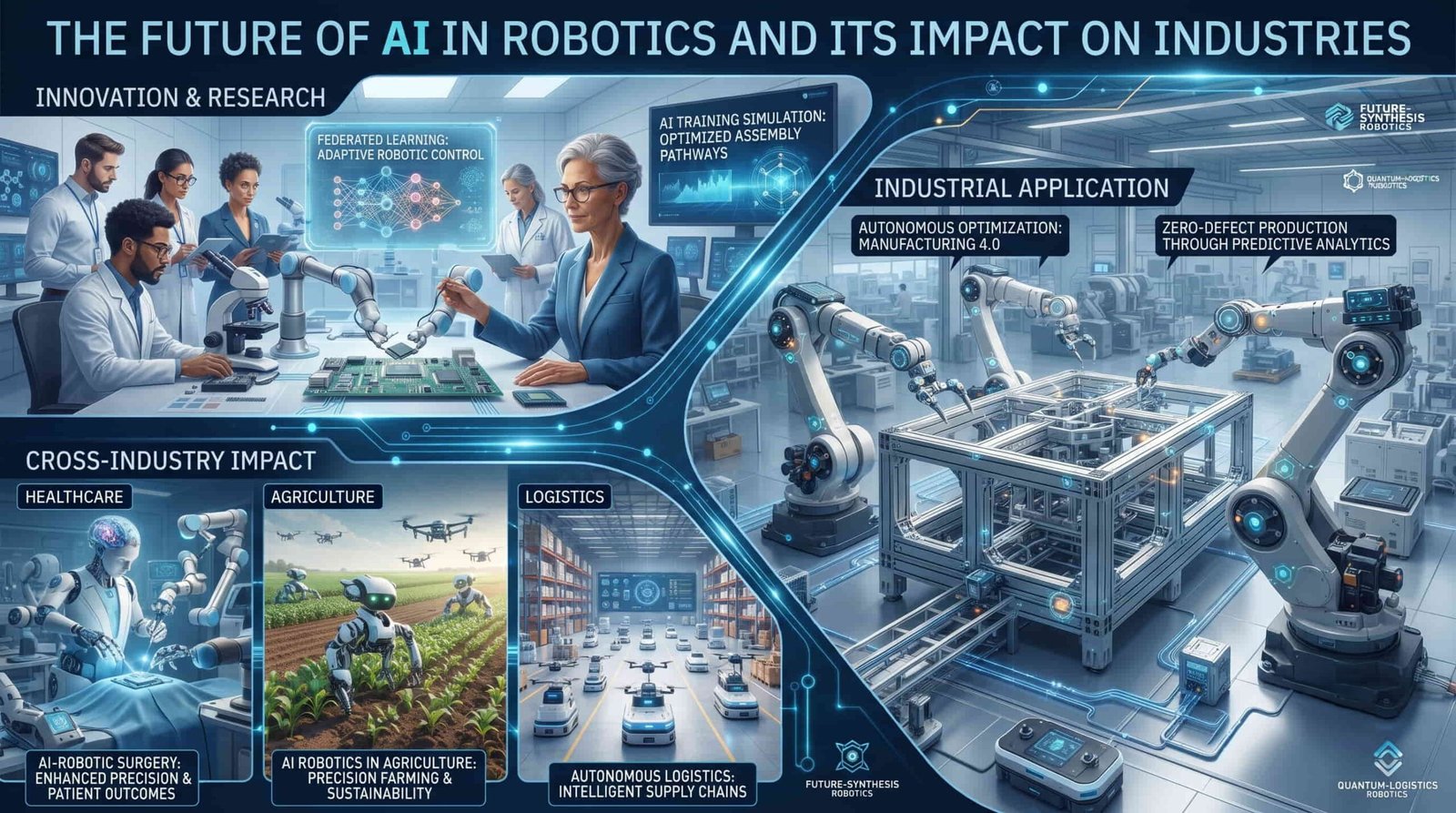
The Future of AI in Robotics and Its Impact on Industries
Artificial Intelligence (AI) is revolutionizing the field of robotics, enabling machines to perform tasks autonomously with increasing efficiency. This article delves into how AI is driving advancements in robotics and its profound impact across various industries.
The Emergence of AI-Driven Robotics
Robots equipped with artificial intelligence are becoming increasingly prevalent, offering enhanced autonomy that was once the realm of science fiction. The integration of different types of AI technologies—analytical AI, generative AI, and agentic AI—is driving this trend.
Analytical AI: Processing Data for Insights
Analytical AI is instrumental in processing large datasets to detect patterns and provide actionable insights. This capability allows robots to anticipate failures before they occur, optimizing operations in smart factories or logistics through advanced path planning and resource allocation.
An example of analytical AI in action can be seen in predictive maintenance within manufacturing environments. By analyzing historical data from sensors and machinery, these systems can predict when a machine is likely to fail, allowing for proactive maintenance schedules that minimize downtime.
Generative AI: Learning New Tasks
Generative AI represents a significant shift from rule-based automation to intelligent systems capable of self-evolution and learning. These systems can generate new outputs, enabling robots to learn new tasks autonomously and create training data through simulation.
A practical application of generative AI is in the development of training scenarios for service robots. By simulating a wide range of real-world situations, these robots can adapt to different environments and improve their performance over time.
Agentic AI: Hybrid Approach for Complex Environments
The hybrid approach of agentic AI combines the structured decision-making of analytical AI with the adaptability of generative AI. This technology aims to equip modern robotics with the ability to operate independently in complex, real-world settings.
In a warehouse setting, a robot equipped with agentic AI can navigate through a variety of tasks, from picking items off shelves to sorting and packaging them. The system’s adaptability allows it to handle unexpected changes or obstacles without human intervention.
The Convergence of IT and OT
Robots are gaining versatility as the integration of Information Technology (IT) and Operational Technology (OT) accelerates. This convergence enhances robotics capabilities through real-time data exchange, automation, and advanced analytics.
In a smart factory environment, IT’s data-processing power combined with OT’s physical control capabilities can optimize production lines in real time. For instance, sensors integrated into the manufacturing process provide continuous feedback to the system, allowing for just-in-time adjustments that reduce waste and improve efficiency.
The Digital Enterprise and Industry 4.0
IT/OT convergence is a fundamental component of the digital enterprise and Industry 4.0. By breaking down silos between the digital and physical worlds, this integration creates seamless data flows that significantly enhance robotics capabilities.
| Benefit | Description |
|---|---|
| Real-Time Data Exchange | Facilitates instant communication between digital and physical systems, enabling dynamic adjustments. |
| Automation Enhancements | Enables more efficient automation processes through advanced analytics and real-time data processing. |
| Advanced Analytics | Supports complex decision-making by leveraging both historical and real-time data for insights. |
The Rise of Humanoid Robots in Industrial Applications
The field of humanoid robotics is expanding rapidly, with applications moving beyond prototypes into real-world deployments. These robots are seen as a promising technology for environments requiring flexibility and designed for human interaction.
In the automotive industry, early adopters like BMW have implemented humanoid robots in their production lines to assist workers in tasks such as assembly and quality control. This collaboration improves efficiency while maintaining the human touch necessary for certain processes.
Reliability and Efficiency
To succeed in competing with traditional automation, humanoid robots must match high industrial standards in terms of cycle times, energy consumption, and maintenance costs. Safety levels, durability criteria, and consistent performance are also critical factors that need to be met.
A key measure for the efficiency of humanoid robots is their ability to achieve human-level dexterity and productivity. This not only ensures they can perform tasks as effectively as humans but also allows them to take on roles where human intervention would be dangerous or impractical.
Robots as Alliances in Tackling Labor Gaps
The global labor market is grappling with a shortage of skilled workers, leading to increased stress and fatigue among existing staff. Adopting robotics and automation can address these issues by filling labor gaps and taking over routine tasks.
A company in the electronics industry might use robotic arms for assembly line work that requires precision and consistency. By handling repetitive tasks, robots free up human workers to focus on more complex or creative aspects of production, reducing stress levels and improving job satisfaction.
Cooperation with Human Workforces
The close cooperation between humans and robots is crucial for acceptance in both industrial settings and service applications. Employers can leverage this partnership to enhance workplace attractiveness and encourage young people to enter the field.
| Benefit | Description |
|---|---|
| Tackling Labor Shortages | Rapidly growing industries can benefit from the added capacity provided by robots, helping to fill labor gaps. |
| Routine Task Automation | Robots can take over repetitive and mundane tasks, allowing human workers to focus on more complex challenges. |
| New Career Opportunities | The integration of robotics creates new roles that require specialized skills, opening up opportunities for upskilling and reskilling programs. |
Challenges and Governance in AI-Driven Robotics
As robots increasingly operate alongside humans, safety becomes a paramount concern. The AI-driven autonomy of these systems necessitates rigorous testing, validation, and human oversight to ensure they operate safely within the workplace.
In the context of humanoid robots, compliance with ISO safety standards is essential. These standards provide a framework for designing and certifying robotic systems that can operate in complex environments while minimizing risks to human workers.
Security Concerns in AI-Driven Robotics
The rapid expansion of robotics into cloud-connected and AI-driven environments exposes industrial production to new cybersecurity threats. These include hacking attempts targeting robot controllers, potential unauthorized access, and system manipulation.
| Threat | Description |
|---|---|
| Hacking Attempts on Controllers | Malicious actors can gain unauthorized access to robot controllers, potentially disrupting operations or causing damage. |
| Unauthorized Access to Data | Sensitive data collected by robots—including video and sensor streams—could be compromised, leading to privacy breaches. |
| Manipulation of Systems | Deep learning models can produce unpredictable outcomes, making it difficult for developers to explain or control the results generated by AI systems. |
-
- What are the main types of AI in robotics?
The main types of AI in robotics include analytical AI, which processes large datasets to provide insights; generative AI, which creates new outputs and enables autonomous learning; and agentic AI, which combines structured decision-making with adaptability for complex environments.
-
- How does IT/OT convergence enhance robotics?
IT/OT convergence enhances robotics by allowing real-time data exchange, advanced analytics, and increased automation. This integration breaks down the silos between digital and physical systems, improving overall efficiency and performance in various industries.
-
- Why are humanoid robots important for industrial applications?
Humanoid robots are essential for environments requiring flexibility and human interaction. They can perform tasks that need both precision and adaptability, reducing the risk of human injury while increasing efficiency and productivity.
-
- What challenges do AI-driven robotics pose to safety standards?
The primary challenge is ensuring that robots operate safely within complex environments. This requires compliance with ISO safety standards, clear liability frameworks, and rigorous testing and validation processes to prevent accidents and ensure human-machine interaction remains safe.
-
- How do cybersecurity threats impact AI-driven robotics?
Cybersecurity threats can lead to unauthorized access, system manipulation, and privacy breaches. These risks are particularly significant in cloud-connected environments where sensitive data is collected by robots. Robust security measures and clear governance frameworks are essential to mitigate these risks.
Conclusion
The integration of artificial intelligence into robotics has transformed the way industries operate, offering unprecedented levels of efficiency and adaptability. As we move forward, the key will be to address safety, security, and governance challenges while harnessing the full potential of AI-driven robotics.