

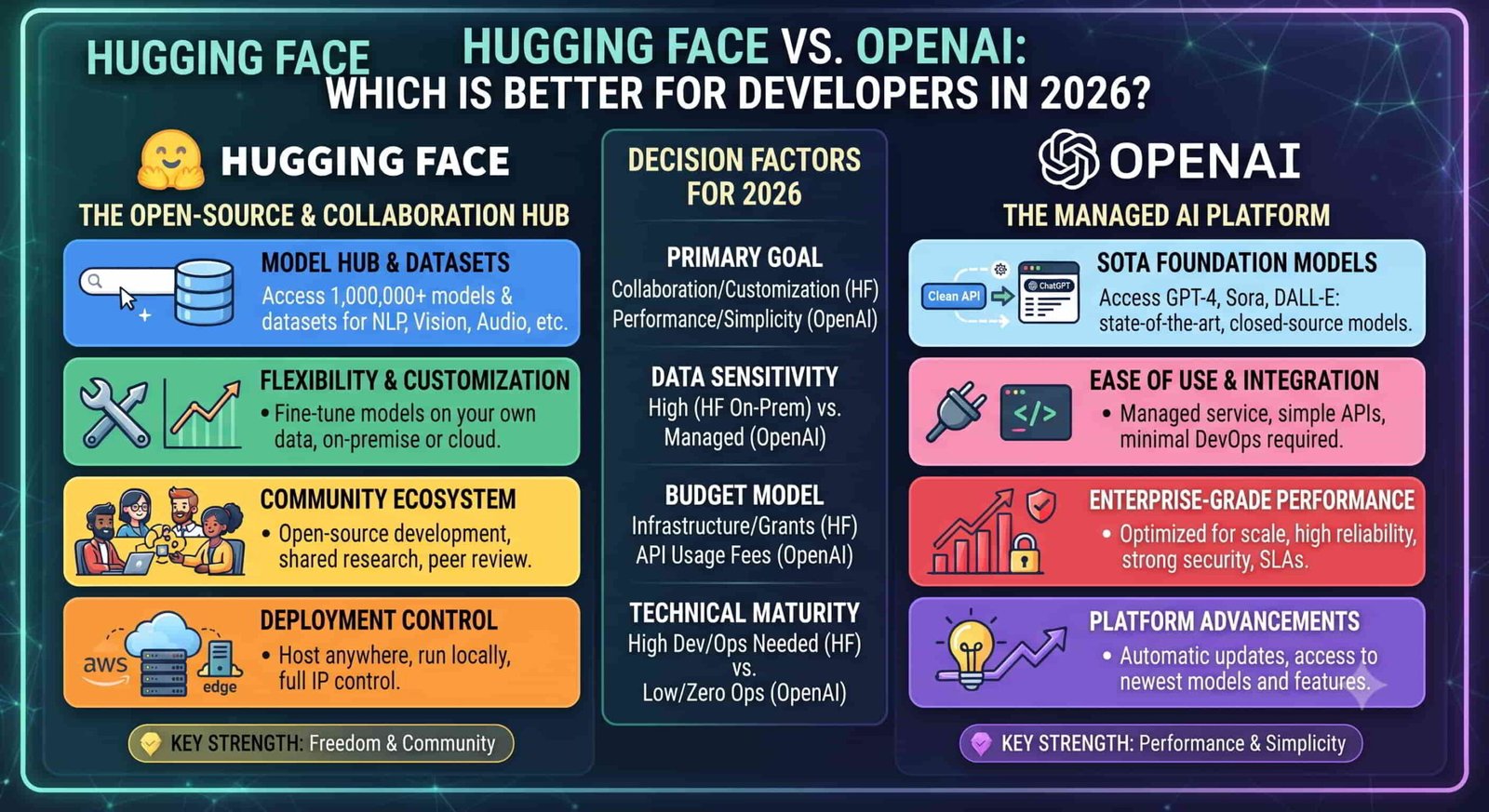
Hugging Face vs OpenAI: Which Platform Is Better for AI Development in 2026?
Introduction
Artificial Intelligence development has evolved rapidly, but two names consistently define the modern developer stack: OpenAI and Hugging Face.
Both platforms have shaped the AI landscape. OpenAI popularized frontier large language models through ChatGPT and managed APIs, while Hugging Face became the central ecosystem for open-source AI collaboration, model hosting, and custom deployment.
For developers and engineering leaders, the distinction can be confusing. Many assume they are direct competitors offering identical services. In reality, they solve different engineering problems and frequently complement each other in production.
┌─────────────────────────────────────────────────────────────┐
│                 Modern AI Architecture Tradeoff             │
├──────────────────────────────┬──────────────────────────────┤
│ OpenAI                       │ Hugging Face                 │
│ • Closed-source, managed API │ • Open-source model hub      │
│ • Out-of-the-box reasoning   │ • Full weights & code access │
│ • Fast time-to-market        │ • Complete data privacy      │
│ • Zero GPU management        │ • Custom fine-tuning & MLOps │
└──────────────────────────────┴──────────────────────────────┘
The question is rarely which platform is universally superior. The real decision hinges on which platform matches your specific technical requirements, privacy constraints, and unit economics.
Core Comparison: Managed API vs. Open Ecosystem
| Dimension | OpenAI | Hugging Face |
| Model Access | Proprietary APIs (e.g., GPT-4o, o1, o3-mini) | Open-weights repository (LLaMA, Mistral, DeepSeek, Qwen) |
| Hosting & Infrastructure | 100% managed by OpenAI | Self-hosted (on-prem/cloud) or Hugging Face Endpoints |
| Data Privacy | Cloud API (Enterprise zero-retention terms available) | Air-gapped / Private Virtual Cloud (VPC) deployments |
| Customization | Prompting, API fine-tuning, Assistants API | Full weight adaptation (LoRA/QLoRA), architecture edits |
| Pricing Model | Token-based usage ($ per million tokens) | Compute-based (hourly GPU costs or self-hosted servers) |
| Setup Complexity | Minimal (Standard HTTP requests) | Moderate to High (Requires ML pipeline and GPU management) |
OpenAI: The Managed AI Experience
OpenAI’s greatest strength is developer velocity. Teams can integrate world-class frontier intelligence into web and mobile applications with standard REST API calls.
Advantages of OpenAI
-
Zero Infrastructure Overhead: No need to provision Nvidia H100s, manage Kubernetes clusters, or tune inference engines.
-
State-of-the-Art General Reasoning: Frontier models handle complex multi-step reasoning, multimodal tasks, and instruction following with minimal prompt engineering.
-
Rapid Prototyping: A functioning Proof of Concept (POC) for a customer support agent or document summarizer can be shipped in an afternoon.
The Tradeoffs
-
Vendor Lock-In: Your product is tethered to OpenAI’s uptime, regional availability, and pricing updates.
-
Black-Box Architecture: Developers cannot inspect internal model weights, training distributions, or token probabilities.
-
Linear Scaling Costs: At millions of daily active requests, token-based pricing can become significantly more expensive than running dedicated, optimized open-source instances.
Hugging Face: The Open AI Ecosystem
Hugging Face operates as the decentralized hub for modern machine learning. Rather than locking developers into a single vendor’s roadmap, it provides access to over a million open-source models built by research teams like Meta, Mistral, Alibaba, Google, and independent laboratories.
Advantages of Hugging Face
-
Complete Architectural Control: Inspect, prune, quantize, and modify underlying model layers directly in PyTorch or JAX.
-
Uncompromised Data Privacy: Deploy models inside an isolated on-premises data center or private VPC, ensuring sensitive enterprise records never leave internal perimeters.
-
Domain Specialization: Fine-tune compact 7B–14B models on proprietary medical, legal, or financial data to outperform massive general-purpose models at a fraction of the compute cost.
-
Modal Diversity: Host and run specialized models for niche tasks like computer vision, audio synthesis, protein folding, and robotics control.
The Tradeoffs
-
Operational Complexity: Managing GPU clusters, optimizing batch sizes, and maintaining inference latency requires dedicated MLOps expertise.
-
Upfront Engineering Investment: Setting up production-ready pipelines with tools like vLLM, TGI, or Triton Inference Server requires dedicated setup time.
Direct Architectural Breakdown
1. Fine-Tuning & Customization
-
OpenAI: Offers managed fine-tuning via API for specific base models. While simple and effective for tone alignment, you cannot export the resulting weights or modify the loss function.
-
Hugging Face: Enables parameter-efficient fine-tuning (PEFT/LoRA/QLoRA) using tools like
transformers,accelerate, andtrl. You retain full intellectual property (IP) and ownership over the resulting model artifacts.
2. Privacy & Compliance
-
OpenAI: Requires data transmission over the public internet to managed endpoints. While enterprise tiers offer SOC2 compliance and zero-data-retention agreements, strictly regulated industries (e.g., defense, public healthcare) often prohibit external API calls.
-
Hugging Face: Open weights can be deployed in fully air-gapped environments, ensuring absolute compliance with HIPAA, GDPR, and sovereign data governance regulations.
3. Economics at Scale
Cost
 ▲
 │                       /  OpenAI (High-Volume Token Scaling)
 │                      /
 │                     /
 │                    /
 │    ───────────────/──────── Hugging Face (Fixed Dedicated GPU Costs)
 │   /
 │  /
 └─┴──────────────────────────────► Request Volume
-
Low to Moderate Volume: OpenAI’s pay-as-you-go token pricing is cheaper because you pay only for active compute.
-
High Volume (Enterprise Scale): Self-hosting an open-source model (like LLaMA or Mistral) on dedicated hardware creates a fixed monthly cost that can be 60–80% cheaper at massive token volumes.
Which Should You Choose?
                              ┌─────────────────────────────┐
                              │  What is your primary goal? │
                              └──────────────┬──────────────┘
                                             │
                     ┌───────────────────────┴───────────────────────┐
                     ▼                                               ▼
         [ Fast Time-to-Market / ]                       [ Strict Privacy / Custom IP / ]
         [ Low Engineering Overhead]                     [ Massive Enterprise Scale     ]
                     │                                               │
                     ▼                                               ▼
             Choose **OpenAI**                            Choose **Hugging Face**
Choose OpenAI if:
-
You are building a fast MVP or startup product with limited machine learning engineering resources.
-
You need complex multimodal reasoning and general intelligence out of the box.
-
Your query volume is unpredictable and variable, making managed infrastructure more cost-effective.
Choose Hugging Face if:
-
Your application handles sensitive, proprietary, or regulated data that must stay within a private cloud.
-
You are fine-tuning a specialized model on proprietary internal datasets.
-
You want to avoid single-vendor lock-in and retain complete ownership of your AI artifacts.
-
Your production scale is large enough that dedicated GPU instances significantly reduce per-token operating expenses.
The Hybrid Approach: Modern Production Strategy
Production teams rarely treat this as an all-or-nothing choice. Modern enterprise architectures commonly adopt a hybrid approach:
-
Routing & Triage: A lightweight, self-hosted open-source model (via Hugging Face) processes standard user queries, classification, and embeddings at near-zero incremental cost.
-
Complex Fallback: High-complexity edge cases, deep reasoning steps, and creative generation are dynamically routed to frontier APIs (like OpenAI).
This architecture delivers low latency and controlled unit economics without sacrificing access to state-of-the-art reasoning capabilities.