

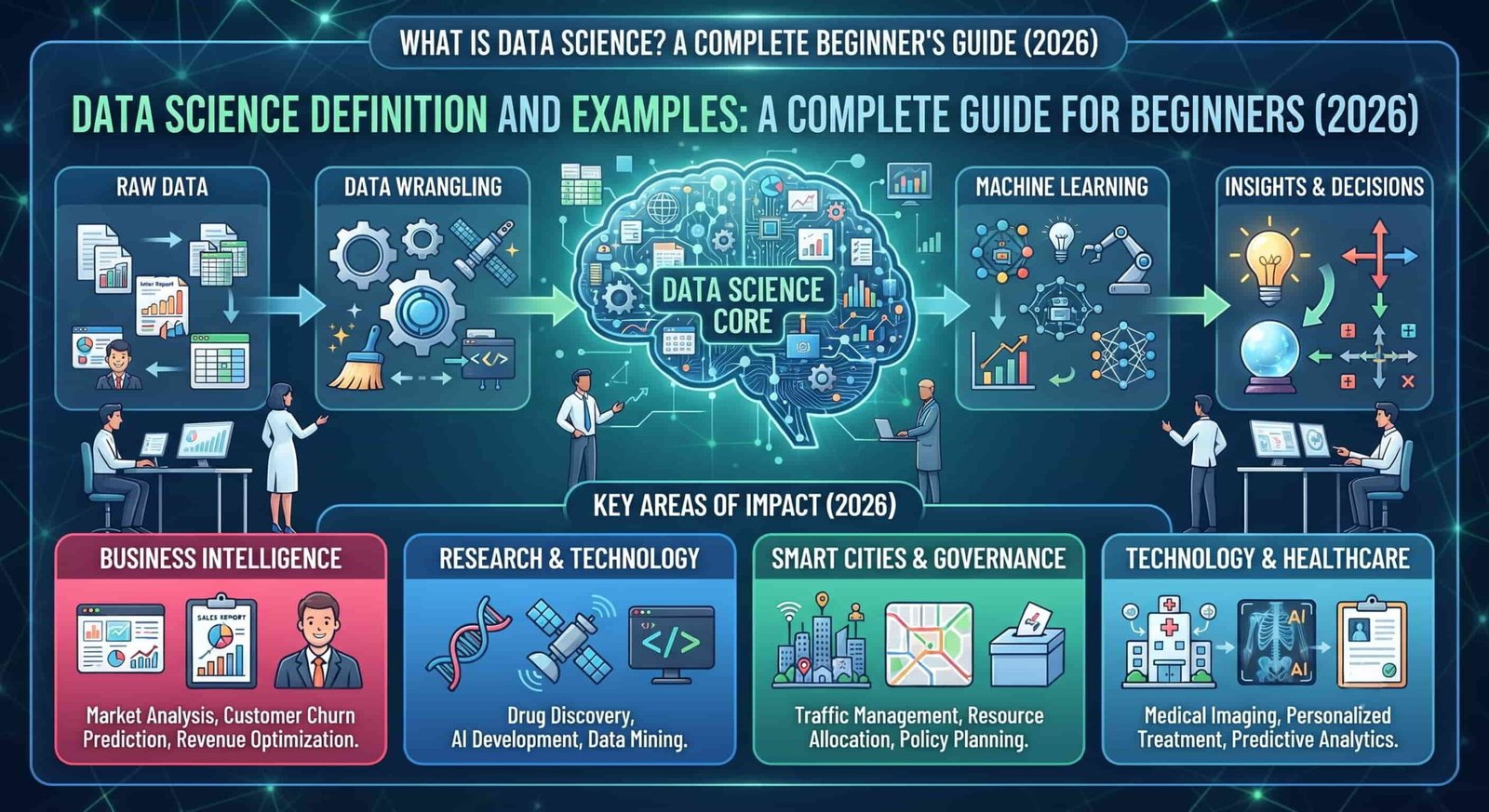
Data Science Definition and Examples
Introduction
Data Science has become one of the most critical fields in the modern digital landscape. Businesses, healthcare providers, financial institutions, and tech giants rely on it to make sense of vast streams of information, solve complex challenges, and make smarter, automated decisions.
Despite its ubiquity, beginners often encounter confusion around three core questions:
-
What is the precise definition of Data Science?
-
How does it apply across different sectors?
-
What are concrete, real-world examples of Data Science in action?
This guide breaks down the core definitions, fundamental components, and practical real-world applications of Data Science.
Defining Data Science
At its simplest, Data Science is the practice of collecting, cleaning, analyzing, and interpreting data to solve problems and guide strategic decisions.
                  ┌───────────────────────┐
                  │      Data Science     │
                  └───────────┬───────────┘
         ┌────────────────────┼────────────────────┐
         ▼                    ▼                    ▼
┌─────────────────┐  ┌─────────────────┐  ┌─────────────────┐
│ Math/Statistics │  │   Programming   │  │ Domain Expertise│
└─────────────────┘  └─────────────────┘  └─────────────────┘
Formal Technical Definition: Data Science is an interdisciplinary field that applies scientific methods, statistical algorithms, computational systems, and domain expertise to extract structured knowledge and actionable patterns from raw, complex data.
The Core Analytics Questions
Raw data on its own is low-value noise. Data Science turns raw data into value by answering four progressive questions:
| Question Type | Focus | Example Business Query |
| Descriptive | What happened? | Which product generated the highest revenue last month? |
| Diagnostic | Why did it happen? | Why did user drop-off spike during checkout? |
| Predictive | What will happen? | Which subscription accounts are likely to cancel next quarter? |
| Prescriptive | What action should we take? | What personalized discount will retain this customer? |
Core Components of Data Science
The discipline integrates multiple technical pillars to process and interpret data at scale:
-
Statistics & Mathematics: Provides probability models, regression analysis, and hypothesis testing to validate patterns.
-
Programming & Computation: Employs languages like Python, SQL, and R to clean, transform, and manipulate massive datasets.
-
Data Engineering & Analysis: Manages databases, pipelines, and exploratory checks using libraries such as Pandas and Polars.
-
Machine Learning & AI: Uses algorithms (e.g., Scikit-Learn, PyTorch, TensorFlow) to learn patterns from historical data and make automated forecasts.
-
Data Visualization: Employs tools like Tableau, Power BI, and Matplotlib to make technical insights accessible to executive stakeholders.
Real-World Examples of Data Science in Action
Data Science powers many everyday digital tools and industrial workflows.
1. Media Streaming Recommendations (Netflix & Spotify)
Streaming platforms analyze viewing history, time spent watching, explicit ratings, search queries, and device types. Recommendation algorithms compare this activity against millions of other users to predict the exact movies or playlists an individual is most likely to enjoy next.
2. Banking Fraud Detection
Financial institutions process millions of card transactions per minute. Machine learning models evaluate transaction size, geographic location, merchant type, and device fingerprint in real time, automatically blocking transactions that deviate from a customer’s baseline behavior.
3. Healthcare Diagnostics and Risk Prediction
Hospitals apply computer vision algorithms to medical imagery (X-rays, CT scans, MRIs) to identify anomalies such as tumors earlier than traditional screening methods. Predictive models also analyze patient vitals to forecast post-surgery readmission risks.
4. Dynamic Pricing & Ride-Sharing (Uber & Lyft)
Ride-hailing apps leverage real-time spatial data, traffic conditions, driver availability, and historical demand patterns to dynamically adjust pricing (surge pricing) and optimize passenger pick-up routing.
5. Supply Chain and Retail Forecasting (Amazon)
E-commerce networks use time-series forecasting to predict localized product demand months in advance. This ensures fulfillment centers are stocked with the right inventory before customers even click “Buy.”
Industry Use Cases at a Glance
| Industry | Primary Use Cases | Business Impact |
| Finance | Credit scoring, algorithmic trading, fraud alerts | Lower default rates and minimized fraud losses |
| Healthcare | Drug discovery, genomic analysis, medical imaging | Faster diagnoses and customized treatment plans |
| Retail & E-Commerce | Customer churn prediction, demand forecasting | Higher average order value (AOV) and optimized inventory |
| Manufacturing | Predictive maintenance, automated QA inspection | Reduced machine downtime and fewer defective parts |
| Transportation | Route optimization, autonomous navigation | Lower fuel consumption and reduced delivery transit times |
The Relationship Between Data Science and AI
Data Science serves as the foundation for modern Artificial Intelligence.
┌────────────────────────────────────────────────────────┐
│                      Data Science                      │
│  ┌──────────────────────────────────────────────────┐  │
│  │                 Machine Learning                 │  │
│  │  ┌────────────────────────────────────────────┐  │  │
│  │  │        Deep Learning & Generative AI       │  │  │
│  │  └────────────────────────────────────────────┘  │  │
│  └──────────────────────────────────────────────────┘  │
└────────────────────────────────────────────────────────┘
Generative AI models and autonomous systems require vast pipelines of curated, cleaned, and labeled data to function safely and accurately. Data scientists build the pipelines, perform feature engineering, and design the validation frameworks that make reliable AI possible.
Conclusion
Data Science is the systematic practice of transforming raw, disparate data into actionable insights and automated decisions. By bridging statistical rigor, computational speed, and domain-specific knowledge, it fuels everything from daily media recommendations to life-saving medical discoveries.
Understanding its definitions and applications provides the essential groundwork for anyone looking to build solutions in analytics, machine learning, and artificial intelligence.