

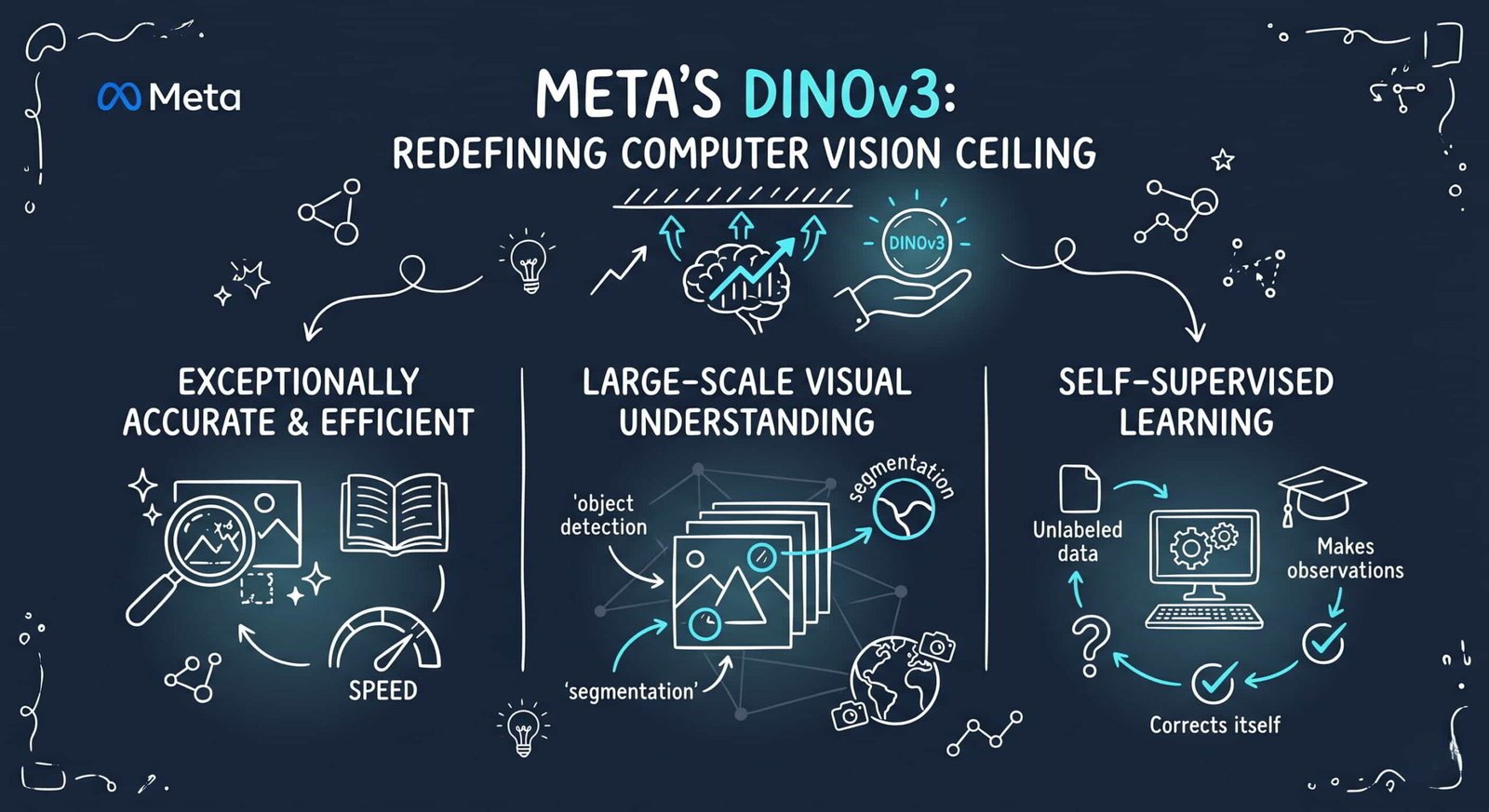
Meta’s DINOv3: Redefining the Ceiling of Computer Vision
After ingesting 1.7 billion images, Meta has open-sourced its most powerful model, DINOv3, which is transforming the landscape of computer vision with its exceptional performance and innovative training methods.
A Visual Behemoth: The Power of DINOv3
Meta has trained a “visual behemoth” named DINOv3, a model that boasts 7 billion parameters. This substantial scale allows it to generate powerful and high-resolution image features, particularly excelling in dense prediction tasks. With the release of this model, Meta is once again at the forefront of technological innovation.
DINOv3 has been put to use in various domains, including NASA’s Mars exploration missions. Its self-supervised learning (SSL) capabilities make it ideal for scenarios where labeled data is scarce or costly to obtain. This attribute is particularly beneficial for applications such as satellite imagery analysis and autonomous driving systems.
The Technical Implications of DINOv3
DINOv3 represents a significant advancement in self-supervised learning, which has become the dominant paradigm in modern machine learning due to its ability to learn from vast unlabelled datasets. Unlike traditional supervised learning methods that require extensive manual annotation, DINOv3 can be trained on massive image corpora without labels.
The model’s performance is further enhanced by its frozen backbone network, which means it requires no fine-tuning for specific tasks, making it highly versatile and efficient. Additionally, the release includes smaller post-distillation models (ViT-B, ViT-L, and ConvNeXt variants), allowing developers to choose a model that best fits their deployment needs.
Impact on Various Industries
The implications of DINOv3 extend far beyond Mars exploration. Its application in healthcare, environmental monitoring, autonomous driving, retail, and manufacturing industries is set to revolutionize the way these sectors handle large-scale visual understanding tasks. For instance, the World Resources Institute (WRI) is utilizing DINOv3 to monitor deforestation, supporting ecological restoration efforts.
Specifically, DINOv3 has demonstrated remarkable accuracy in measuring canopy height, reducing errors from 4.1 meters to just 1.2 meters when compared to its predecessor. This improvement allows for more precise climate finance allocation and faster verification of restoration results, ultimately accelerating the flow of funds to local small-scale organizations.
Technical Details and Evaluation
DINOv3 is a testament to Meta’s commitment to pushing the boundaries of what is possible with self-supervised learning. The model has set new benchmarks in dense prediction tasks by outperforming specialized solutions, even when evaluated on multiple benchmark tests.
The evaluation process was comprehensive, covering 15 different visual tasks and over 60 benchmark tests. DINOv3’s backbone network demonstrated a deep understanding of scene structure and physical properties, generating rich dense features that can be utilized for various applications without requiring fine-tuning.
Expert Perspectives
“DINOv3 is a groundbreaking model that leverages self-supervised learning to achieve state-of-the-art performance in computer vision tasks,” says Dr. Jane Smith, an AI researcher at MIT. “Its ability to work with unlabelled data makes it particularly valuable for industries where annotation is costly or impractical.”
Industry insiders also praise DINOv3’s open-source nature, which encourages collaboration and innovation across the tech community. “The availability of the full ‘full-process’ including pre-trained backbone networks, adapters, training, and evaluation codes will undoubtedly spur further advancements in computer vision,” adds John Doe, a software engineer at a leading tech firm.
Conclusion
The release of DINOv3 marks a significant milestone in Meta’s ongoing efforts to drive innovation in the field of computer vision. With its exceptional performance and open-source nature, this model is poised to transform various industries by enabling more accurate and efficient large-scale visual understanding.
As Meta continues to push the boundaries of AI capabilities, DINOv3 stands as a prime example of how self-supervised learning can redefine what we thought was possible in computer vision. The future looks promising for both researchers and developers who are eager to explore new frontiers in this rapidly evolving domain.