
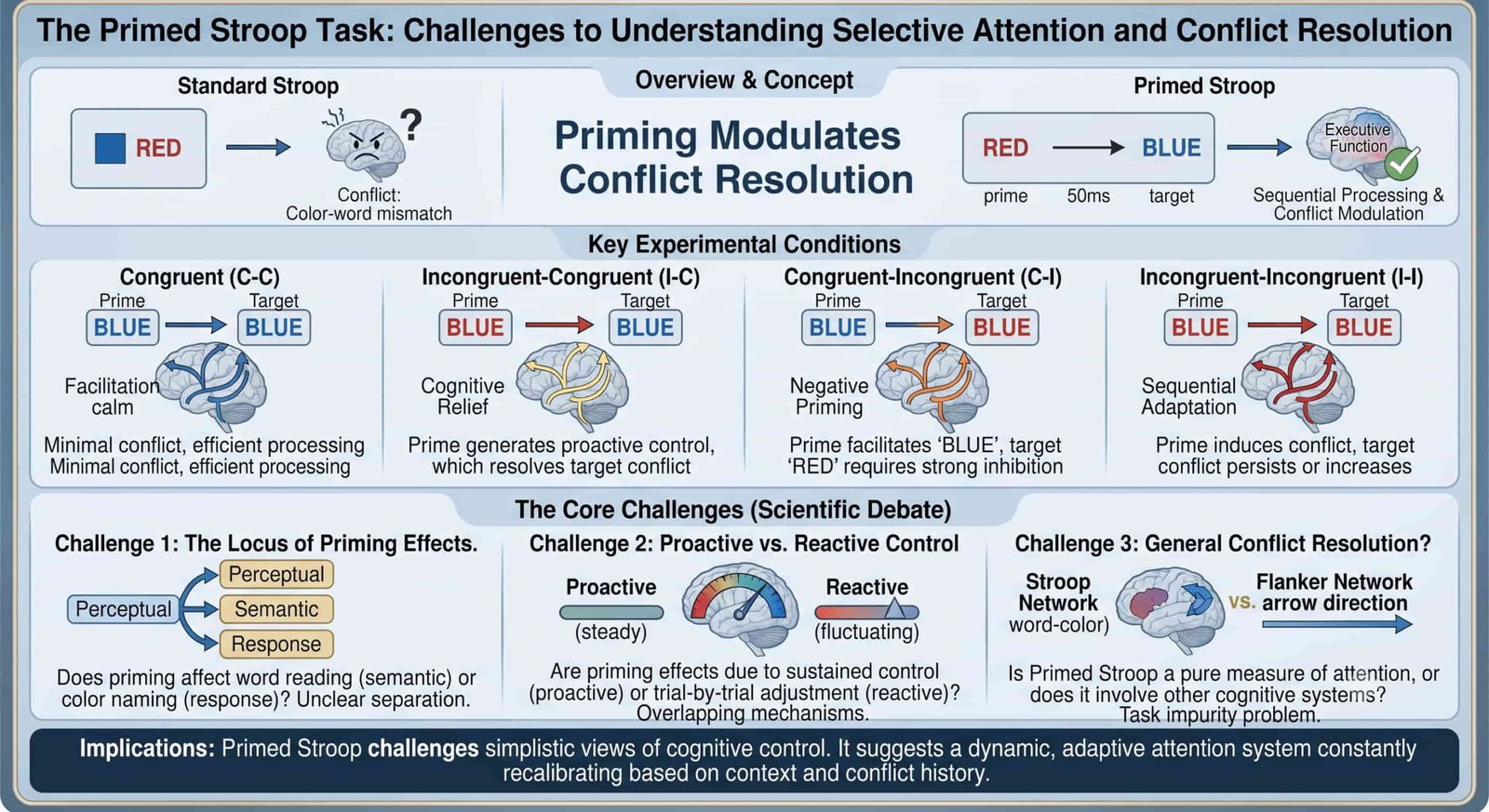
The Primed Stroop Task: Challenges to Understanding Selective Attention and Conflict Resolution
By Samantha Curtis, ORCID: orcid.org/0009-0007-0326-430X
Introduction to the Primed Stroop Task
The classic color-word Stroop task, a well-established paradigm in cognitive psychology, reveals how the human brain struggles with selective attention. In this task, words (e.g., GREEN) are printed in different colors (e.g., red), and participants are required to ignore the meaning of the word and respond to the ink color as quickly as possible. The interference effect observed here is a robust phenomenon, where response times for incongruent trials are significantly longer than those for neutral or congruent trials.
While this task has been extensively studied and its effects well-documented, recent research by Curtis et al. (2025) challenges the traditional understanding of Stroop interference by introducing a new variant known as the primed Stroop task. This paper delves into the differences between the standard integrated Stroop task and the primed version, exploring how these variations might impact our understanding of selective attention and conflict resolution.
Understanding the Standard Integrated Stroop Task
The classic color-word Stroop task, as introduced by J. Ridley Stroop in 1935, has become a cornerstone of cognitive psychology research. Participants are asked to name the ink color of words that are printed in different colors (e.g., naming “red” when presented with the word “GREEN” written in red). The interference effect here is significant and consistent across various studies.
Curtis et al. (2025) argue that this robust interference stems from the integrated nature of the Stroop stimulus, where both the word and color are seen as parts of a single object. This integration creates a strong distractor effect, making it difficult for participants to ignore the meaning of the word.
The Primed Stroop Task: A New Twist on Classic Interference
The primed Stroop task, as introduced by Curtis et al. (2025), seeks to disrupt the integration of word and color into a single object. In this variant, the distractor word is presented in monochrome before being followed by the full-color stimulus. By separating the presentation of the word and color, researchers aim to break the perceptual binding between them.
This separation is achieved through a short prime-target stimulus-onset asynchrony (SOA). In Experiment 1, this SOA was set at 550 milliseconds, while in Experiment 2, it was reduced to 250 milliseconds. The goal of these experiments is to observe whether the characteristic positive delta slope observed in the standard Stroop task remains intact or if the priming effect disrupts it.
Experimental Design and Methodology
The study was conducted with participants completing randomly intermixed standard (integrated) and primed Stroop trials. The design allowed researchers to compare the interference effects observed in both conditions systematically.
- Experiment 1: A SOA of 550 milliseconds was used, where the prime-target SOA was extended, allowing for a more significant separation between the presentation of word and color.
- Experiment 2: A shorter SOA of 250 milliseconds was employed to minimize the delay between the primed distractor word and the full-color stimulus.
Results: An Analysis of Interference Effects
The results from both experiments revealed distinct patterns in the interference effects. In the standard task, the interference was large and increased across quantiles, replicating the classic delta plot pattern. This suggests that participants struggled with selective attention, as expected.
In contrast, the primed Stroop task showed a smaller and more constant level of interference across the RT distribution. The resulting delta slope was flat, indicating no significant increase in interference over time. Both long (550 ms) and short (250 ms) SOAs produced similar results.
Discussion: Implications for Conflict Resolution and Selective Attention
The findings from this study support the claim that the robustness of Stroop interference is closely tied to the perceptual integration of word and color. When this integration is disrupted, as in the primed version, the resulting interference effect reflects a qualitatively different mechanism.
This research challenges the traditional view that selective attention failure underlies the Stroop interference. Instead, it suggests that the interference may be more accurately described as evidence accumulation issues – specifically, the rate at which irrelevant information (the word meaning) is processed and integrated with relevant information (the color).
The implication of this finding is significant for our understanding of cognitive processes involved in conflict resolution. It opens up new avenues for research into how attention is distributed between competing stimuli and suggests that automatic processing may play a more crucial role than previously thought.
Conclusion: The Role of Perceptual Integration in Stroop Interference
In conclusion, the primed Stroop task provides strong evidence that the robust nature of Stroop interference is a result of the perceptual integration of word and color into a single object. When this integration is disrupted, the resulting interference effect changes qualitatively, highlighting the importance of this integration in selective attention.
This study not only challenges traditional views but also opens up new questions for future research. How does the disruption of this perceptual binding affect other aspects of cognitive processing? Can we use these findings to better understand and mitigate similar interference effects in everyday tasks?