
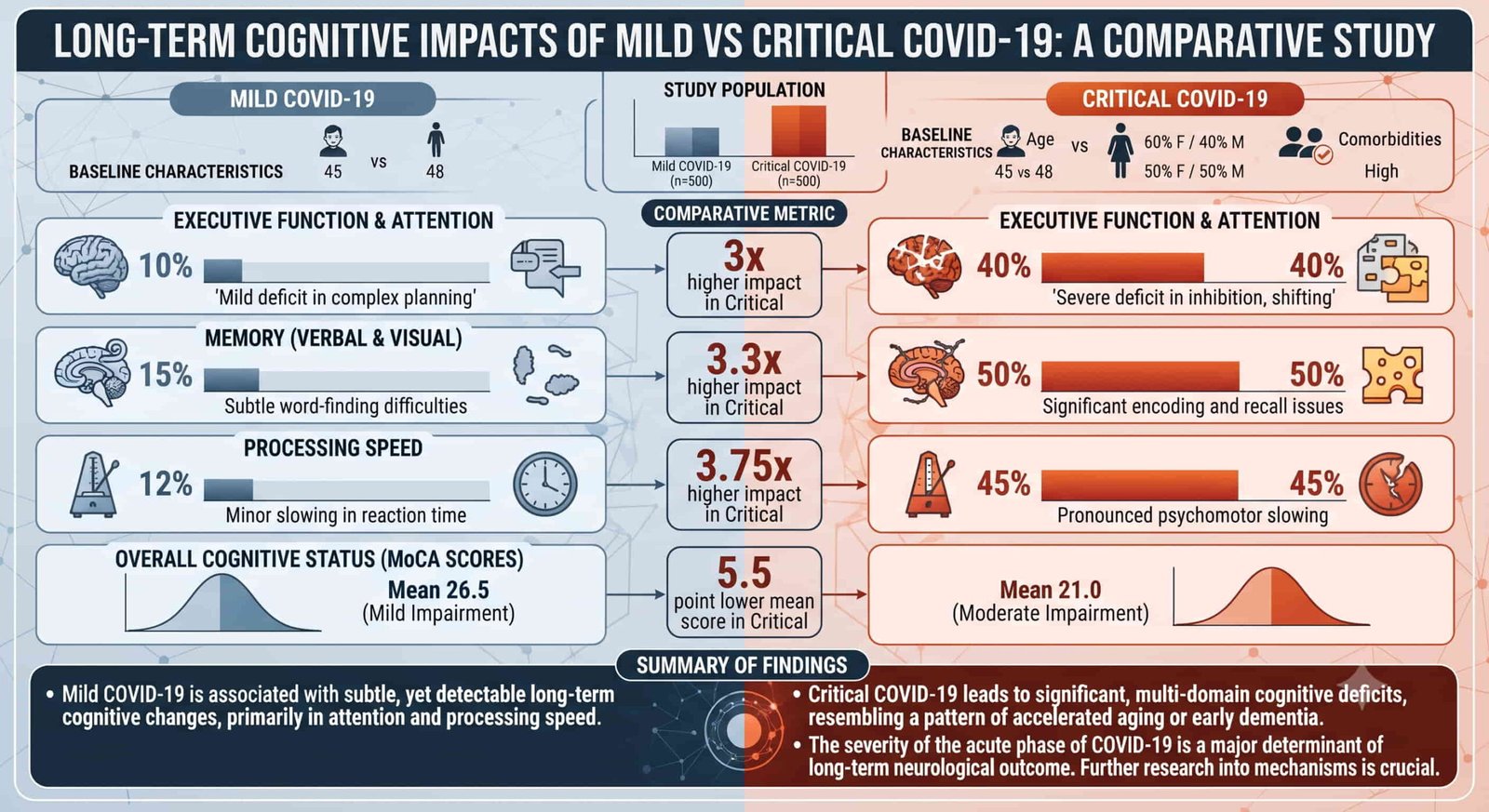
Long-term Cognitive Impacts of Mild vs Critical COVID-19: A Comparative Study
Coronavirus disease 2019 (COVID-19), caused by severe acute respiratory syndrome coronavirus 2 (SARS-CoV-2), has spread rapidly and continues to impact global public health. As a multi-organ disease, the acute phase of COVID-19 can present with a wide spectrum of symptoms, ranging from mild, cold-like manifestations to more severe respiratory complications such as pneumonia and acute respiratory distress syndrome. In severe cases, these complications may necessitate hospitalization in an intensive care unit (ICU) for critical management.
Following acute COVID-19, some individuals may develop post-COVID-19 condition (PCC), defined as persistent or emerging symptoms at least 12 weeks after acute infection that cannot be otherwise explained. PCC often manifests as persistent neurocognitive and neuropsychiatric symptoms, such as cognitive deficits, fatigue, and depression, which negatively affect health-related quality of life (HRQoL) and long-term recovery.
Study Overview
This study examined long-term cognitive, mental, and physical health in patients with varying acute COVID-19 severity (mild to critical), alongside patients critically ill from non-COVID-19 causes. A bicentric prospective observational study was conducted comparing the following groups:
- 30 participants who experienced mild COVID-19
- 14 participants who required ICU care for acute COVID-19
- 7 participants with prolonged non-COVID-19 ICU stays
All assessments were conducted at least 12 weeks post-onset. Comprehensive neuropsychological assessments and evaluations of physical impairments, psychiatric symptoms, fatigue, and health-related quality of life were performed.
Results
Overall cognition was comparable between the mild COVID-19 and ICU groups. However, the mild COVID-19 group experienced higher cognitive fatigue and lower memory satisfaction than both ICU groups. Additionally, the mild COVID-19 group reported a higher rate of anxiety (59% vs. 15%) and depression (38% vs. 15%), with reduced mental health-related quality of life compared to COV-ICU patients.
“Long-term cognitive impairment occurred in PCC patients and ICU survivors, irrespective of acute disease severity.” – Gorsler et al., 2023
| Group | Cognitive Fatigue | Memory Satisfaction | Anxiety | Depression | Mental Health-Related QoL |
|---|---|---|---|---|---|
| Mild COVID-19 | High | Low | 59% | 38% | Reduced |
| ICU (Mild) | Moderate | Normal | 15% | 15% | Normal |
| ICU (Critical) | Moderate | Normal | 15% | 15% | Normal |
The mild COVID-19 group reported greater long-term psychological distress, highlighting the need for further research and support for individuals with PCC.
Discussion
The convergence of findings from this study and previous research prompts a fundamental question: Do enduring neurological deficits after severe COVID-19 stem primarily from the virus, or from the broader toll of critical illness and intensive care? To answer this, Gorsler et al. conducted a prospective, three-arm comparison study. They assessed objective and subjective cognitive impairment alongside other clinical characteristics at least 12 weeks after acute COVID-19 of varying severity.
The results indicate that both mild and critical cases of COVID-19 can lead to long-term cognitive deficits, but the mechanisms underlying these outcomes may differ. Mild cases may result in higher psychological distress, while critical cases may experience more physical impairments and cognitive fatigue.
Conclusion
The findings of this study have significant implications for understanding the long-term cognitive outcomes after mild and critical COVID-19. While both groups experience long-term cognitive deficits, the specific nature and severity of these deficits may differ based on the initial disease severity. This underscores the need for a multifaceted approach to addressing PCC, including psychological support and ongoing neuropsychological assessments.