

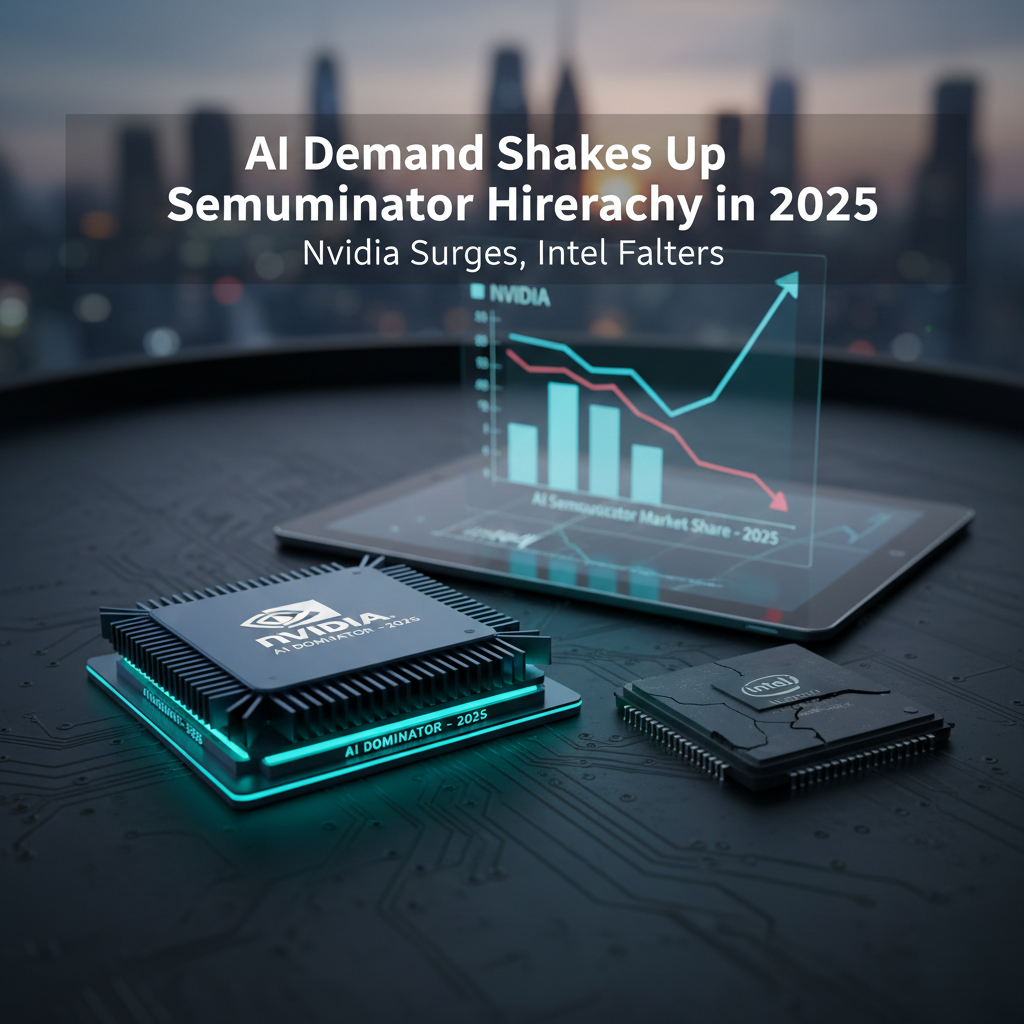
AI Demand Shakes Up Semiconductor Hierarchy in 2025 — Nvidia Surges, Intel Falters
AI Demand Shakes Up Semiconductor Hierarchy in 2025 — Nvidia Surges, Intel Falters – The global semiconductor market saw a major shift in vendor leadership in 2025, driven primarily by unprecedented demand for AI infrastructure chips. According to a new Gartner report, global semiconductor revenue climbed 21% to around $793 billion, with AI-centric processors, memory, and networking components accounting for roughly one-third of all sales — a trend that’s poised to reshape the industry well into 2026 and beyond.
Reference LINK
Market Growth Fueled by AI Infrastructure Spending
Gartner’s latest data reveals that AI demand is no longer a niche driver — it’s the dominant force in semiconductor spending:
- Global semiconductor revenue jumped 21% in 2025 to about $793 billion.
- AI processors alone contributed more than $200 billion to that total.
- Spending on AI infrastructure is expected to continue surging, with forecasts suggesting over $1.3 trillion in AI infrastructure spend in 2026.
According to Rajeev Rajput, a senior principal analyst at Gartner, “AI semiconductors — including processors, high-bandwidth memory, and networking components continued to drive unprecedented growth in the semiconductor market.”
Nvidia Dominates, Intel and Others Adjust Strategy
Nvidia Extends Lead as AI Chip Demand Rises
Nvidia’s GPU-centric product portfolio has helped it leap to the top of the semiconductor vendor rankings, capturing approximately 15.8% of the global market and more than $125 billion in revenue in 2025 — marking a substantial lead over traditional competitors.
The company’s rise underscores a broader industry dynamic: AI workloads require massive parallel compute power that modern GPUs are uniquely positioned to provide, particularly in data center and supercomputing environments.
Intel Losing Ground, Reshaping Its AI Strategy
Once the dominant semiconductor vendor, Intel saw its annual revenue decline by nearly 4% in 2025, slipping in Gartner’s vendor rank as Nvidia surged ahead.
In response, Intel has been emphasizing newer product lines — such as its Core Ultra Series 3 CPUs, which integrate more AI-oriented compute capabilities — and strategic partnerships to bolster competitiveness in the AI era.
Memory Chip Market — Hidden Catalyst Behind the AI Boom
While processors grab headlines, memory chips — especially high-bandwidth memory (HBM) — are a critical infrastructure component of AI accelerators. The rapid growth in GPU-driven AI data centers has driven surging HBM demand and pricing pressures that have both helped suppliers and strained memory markets.
This trend is part of a larger memory supply shift that has tightened availability for consumer and PC markets as vendors allocate capacity toward AI-optimized memory products.
Broader Industry Implications and Competitive Dynamics
Rising Strategic Capex for AI-Fueled Growth
The semiconductor growth story isn’t limited to processors and memory alone. Firms are also investing in advanced manufacturing and capacity expansion to meet AI hardware demand. Recent reports suggest major foundries are ramping capital spending significantly to support next-generation AI chip production.
This aligns with the broader industry anticipation that AI demand will continue to accelerate semiconductor revenue growth through 2026 and beyond.
Shifting Competitive Landscape
AI demand has also catalyzed shifts deeper into semiconductor market share:
- GPU and AI accelerator leaders are carving out larger revenue positions.
- Memory specialists are seeing strong growth tied to AI data center requirements.
- Traditional CPU vendors are increasingly repositioning around hybrid compute + AI workloads.
Emerging players and regional supply chain diversification efforts further complicate the competitive picture, suggesting the semiconductor hierarchy will remain dynamic into 2026.
Conclusion — AI Demand Is Redefining the Semiconductor Order of Battle
The latest Gartner analysis underscores a structural shift in the global semiconductor market: AI infrastructure has morphed from an emerging segment to the primary driver of industry expansion.
With Nvidia extending its lead, memory chip demand surging, and traditional players recalibrating strategy, 2025 may be remembered as the year AI permanently reshaped chip vendor rankings. The ramifications will span technology ecosystems, supply chain strategies, and innovation roadmaps through 2026 and beyond.
Check ALL TECH POST Here !