

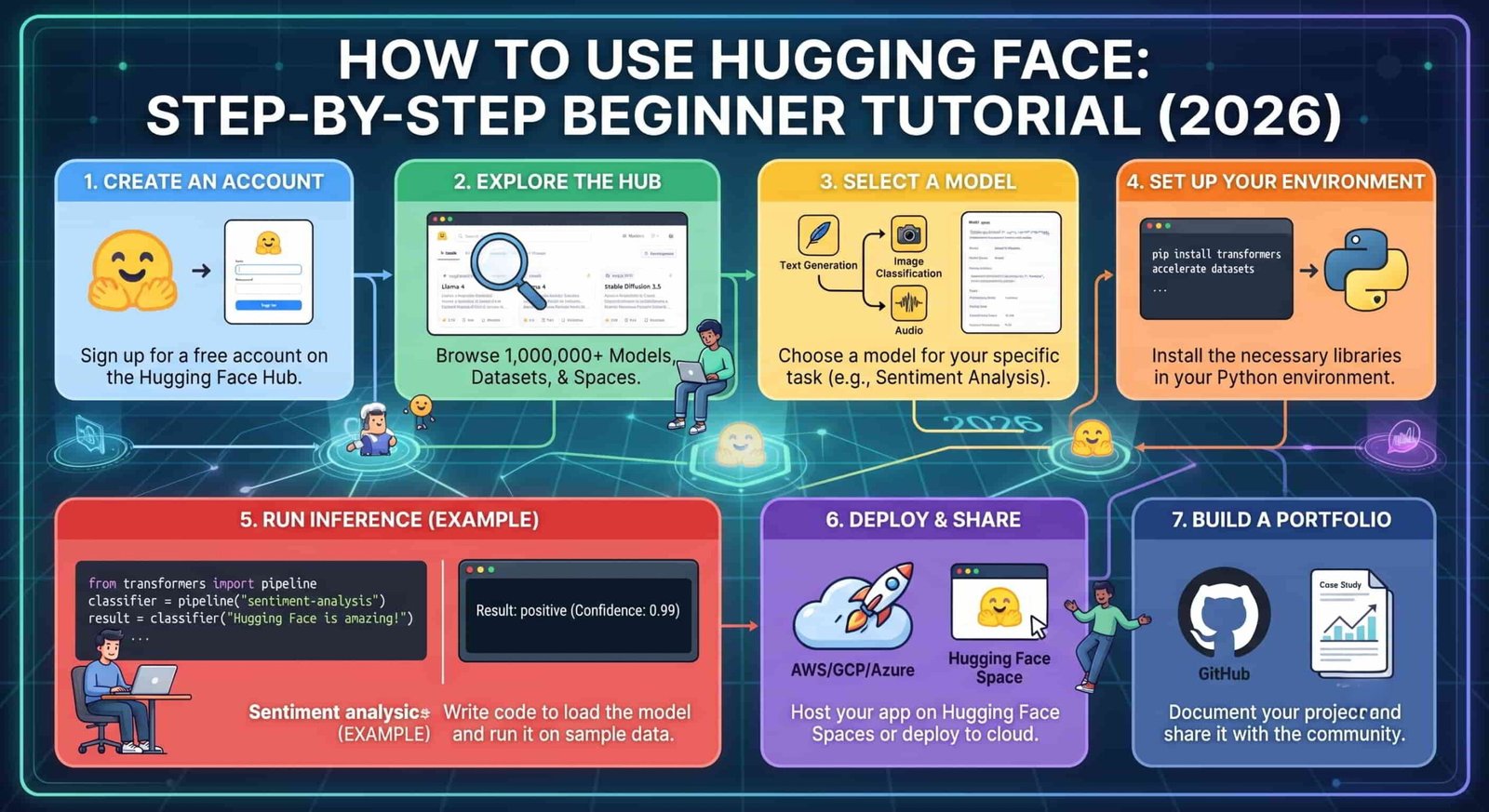
How to Use Hugging Face: Step-by-Step Beginner Tutorial (2026)
Introduction
Over the past few years, Artificial Intelligence has moved from research laboratories into everyday software. Today, AI powers customer support systems, recommendation engines, search platforms, content creation tools, coding assistants, healthcare applications, and countless other technologies that millions of people use daily.
As AI adoption continues to accelerate, one platform has emerged as a central hub for developers, researchers, startups, and enterprises: Hugging Face.
If you’ve spent time exploring machine learning, large language models, generative AI, or data science, you’ve likely encountered Hugging Face. The platform has become the preferred destination for discovering AI models, sharing research, accessing datasets, and deploying intelligent applications. In many ways, it has become the foundation of the modern open-source AI ecosystem.
Yet for many beginners, the platform can feel overwhelming. A first visit often reveals thousands of models, datasets, libraries, applications, and technical terms that make it difficult to know where to start. Questions quickly arise: What should I learn first? Do I need to know machine learning? Can I use Hugging Face without a GPU? How do developers actually build applications with it?
The good news is that getting started is far easier than most people imagine. You don’t need a research background, expensive hardware, or years of experience. What you need is a clear understanding of the platform and a practical roadmap for learning how its ecosystem fits together.
This guide walks through everything a beginner needs to know to start using Hugging Face effectively, from exploring models and datasets to building applications and developing valuable AI skills.
Understanding What Hugging Face Actually Does
Many newcomers mistakenly assume that Hugging Face is simply another AI chatbot company. In reality, Hugging Face serves a much broader purpose.
Rather than building a single AI product, Hugging Face provides the infrastructure that allows developers and organizations to discover, share, evaluate, fine-tune, and deploy machine learning models. The platform hosts models created by leading organizations such as Meta, Google, Microsoft, Mistral AI, Alibaba, NVIDIA, and thousands of independent researchers around the world.
A useful comparison is GitHub. GitHub became the standard platform for hosting and collaborating on software projects. Hugging Face has become the equivalent platform for machine learning and artificial intelligence. Instead of code repositories alone, it hosts model repositories, datasets, demonstrations, benchmarks, documentation, and deployment tools.
This open ecosystem allows developers to build on existing work rather than starting every project from scratch. As a result, tasks that once required months of research can now often be completed within hours.
Start by Exploring Before Building
One of the most common mistakes beginners make is rushing into implementation. After watching a few AI videos or reading about large language models, many people immediately try to train models, fine-tune systems, or build complex applications.
A better approach is to spend time understanding the ecosystem first.
When you visit Hugging Face, explore the Model Hub and observe the diversity of available models. You’ll quickly notice that AI extends far beyond chatbots. The platform contains models for language translation, image generation, speech recognition, document processing, object detection, recommendation systems, sentiment analysis, video understanding, and many other tasks.
As you browse, pay attention to how model pages are structured. Notice the descriptions, performance benchmarks, usage examples, and licensing information. Understanding these components will help you evaluate models more effectively in the future.
This exploration phase may seem simple, but it provides the foundation for everything that follows. The best AI engineers are often those who know how to select the right tools rather than those who attempt to build everything from scratch.
Creating Your Hugging Face Account
Although much of the platform can be explored without registering, creating a free account unlocks several useful capabilities.
An account allows you to save favorite models, follow creators, publish projects, create Spaces, access API tokens, and contribute to the broader AI community. More importantly, it gives you a place to build a professional presence within the machine learning ecosystem.
As AI hiring continues to evolve, recruiters increasingly examine technical portfolios in addition to résumés. Just as software developers showcase projects on GitHub, AI professionals often showcase their work through Hugging Face profiles and public repositories.
Creating an account takes only a few minutes and provides access to features that become increasingly valuable as your skills develop.
Learning How to Evaluate AI Models
One of the most important skills in modern AI development is learning how to evaluate models effectively.
When beginners first discover Hugging Face, they often focus entirely on model popularity. However, professional developers typically evaluate models based on specific criteria such as performance, speed, hardware requirements, licensing restrictions, and intended use cases.
Every model page contains valuable information. The documentation explains what the model was designed to accomplish, how it was trained, where it performs well, and what limitations users should expect. Many pages also include benchmark results that allow comparisons against competing models.
Developing the habit of reading this information carefully will save considerable time and frustration later. Selecting the right model often has a greater impact on project success than any optimization performed afterward.
Running Your First AI Model
One of the reasons Hugging Face became so popular is that it dramatically simplifies experimentation.
Many models can be tested directly within your browser. Instead of configuring environments, installing dependencies, or provisioning cloud infrastructure, you can often enter a prompt and receive results immediately.
This accessibility allows beginners to focus on understanding model behavior rather than worrying about technical setup.
As you experiment, pay attention to how different prompts influence outputs. Observe where models perform well and where they struggle. Notice how specialized models often outperform general-purpose models for specific tasks.
These observations help build intuition, which becomes increasingly valuable as you begin developing your own applications.
Moving Beyond Browser-Based Experiments
Eventually, browser-based experimentation becomes limiting. While testing models interactively is useful, real-world applications require programmatic access.
This is where the Hugging Face Transformers library becomes important.
Transformers provides a standardized framework for loading, running, and integrating machine learning models into software applications. Instead of learning a different interface for every model architecture, developers can work through a consistent API.
This standardization transformed AI development. Before libraries like Transformers existed, implementing advanced machine learning systems often required deep expertise and significant engineering effort. Today, developers can access powerful models using only a few lines of code.
The result is a development experience that feels much closer to traditional software engineering than academic research.
Understanding Why the Transformers Library Changed AI Development
The impact of the Transformers library extends far beyond convenience.
Historically, implementing state-of-the-art machine learning systems required reading research papers, reproducing architectures, training models, and managing extensive infrastructure. This process limited access to a relatively small community of specialists.
Transformers changed that dynamic by making advanced models accessible through simple and consistent interfaces. Developers no longer needed to recreate complex architectures from scratch. Instead, they could focus on solving business problems and building applications.
For startups, this accelerated innovation. For enterprises, it reduced development costs. For students, it created opportunities to learn practical AI without needing access to expensive research environments.
The library effectively democratized access to cutting-edge machine learning technology.
Exploring the Most Important Model Families
As you spend more time on Hugging Face, certain model families begin appearing repeatedly across tutorials, benchmarks, and production systems.
Meta’s LLaMA models have become some of the most influential open-source language models available today. Alibaba’s Qwen family has gained significant attention for its multilingual capabilities, coding performance, and strong reasoning abilities. Mistral models are widely recognized for balancing efficiency and performance, making them attractive choices for production deployments.
Other important models include DeepSeek for programming and reasoning tasks, Whisper for speech recognition, and FLUX for image generation.
Rather than attempting to learn hundreds of individual models, focus on understanding the strengths and trade-offs of major model families. Most experienced AI engineers develop expertise around a relatively small number of ecosystems that consistently perform well for their use cases.
Discovering Hugging Face Spaces
One feature that often surprises newcomers is Hugging Face Spaces.
Spaces allows developers to transform machine learning projects into fully interactive web applications that can be shared publicly. Instead of presenting code snippets or screenshots, developers can publish live demonstrations that users can access directly through a browser.
This capability has become especially valuable for students building portfolios, freelancers attracting clients, startups validating product concepts, and researchers sharing experimental work.
A well-designed Space demonstrates practical implementation skills in a way that documentation alone cannot. Visitors can interact with the application, evaluate results, and understand the project’s functionality immediately.
For aspiring AI engineers, creating public Spaces is one of the most effective ways to showcase technical skills and real-world experience.
Learning from Existing Projects
Many beginners assume that learning AI means building everything independently. In practice, some of the most effective learning occurs through studying existing projects.
Hugging Face hosts thousands of open-source repositories covering virtually every area of artificial intelligence. By examining these projects, beginners gain exposure to production workflows, prompt engineering strategies, application architectures, deployment patterns, and best practices.
Reading code written by experienced developers often accelerates learning far more effectively than starting with a blank page.
Understanding how successful projects are structured provides practical insights that are difficult to obtain from theory alone.
Knowing When Fine-Tuning Becomes Necessary
Fine-tuning receives significant attention in AI discussions, but many beginners attempt it too early.
Before investing time in fine-tuning models, it’s important to understand prompt engineering, model selection, evaluation techniques, data quality, and inference workflows. Many business challenges can be solved effectively using existing models combined with thoughtful prompting strategies.
In practice, organizations frequently discover that selecting a better model produces larger improvements than training a custom version.
Fine-tuning becomes most valuable when applications require specialized knowledge, domain-specific behavior, or unique performance characteristics that cannot be achieved through prompting alone.
Understanding when not to fine-tune is often as important as knowing how to do it.
A Practical Learning Roadmap
A structured learning path helps prevent overwhelm.
During the first month, focus on understanding the Hugging Face ecosystem, exploring models, and experimenting with browser-based inference. The goal is familiarity rather than mastery.
During the second month, begin learning the Transformers library and integrating models into simple Python applications. This stage develops practical implementation skills.
During the third month, build small projects such as document summarizers, AI chatbots, sentiment analysis tools, recommendation systems, or image classification applications. Project-based learning reinforces concepts far more effectively than passive study.
Once these fundamentals become comfortable, begin exploring advanced topics such as Retrieval-Augmented Generation (RAG), vector databases, model deployment, fine-tuning, and production AI engineering.
This progression mirrors the path followed by many successful AI professionals entering the field today.
The Bigger Opportunity
Hugging Face is much more than a repository of machine learning models. It represents one of the most important platforms in the modern AI landscape.
The platform sits at the intersection of open-source collaboration, machine learning research, software engineering, and production deployment. Understanding how to navigate this ecosystem is becoming an increasingly valuable skill for Data Analysts, Data Scientists, Machine Learning Engineers, AI Engineers, and software developers.
As artificial intelligence continues transforming industries, the ability to discover, evaluate, deploy, and customize AI systems will become a core professional competency.
Learning Hugging Face is one of the most practical ways to develop that capability.
Conclusion
The rapid growth of artificial intelligence has created unprecedented opportunities for learners, developers, and businesses. Hugging Face has played a major role in making these opportunities accessible by lowering the barriers that once restricted advanced machine learning to research institutions and large technology companies.
Today, anyone with curiosity and a willingness to learn can begin exploring state-of-the-art AI models, building applications, and contributing to the broader AI ecosystem.
The journey does not start with training massive models or deploying complex systems. It starts with understanding the platform, experimenting with available tools, studying successful projects, and gradually building practical experience.
As your skills grow, you’ll discover that Hugging Face is more than a tool. It is a gateway into the future of artificial intelligence and one of the most valuable platforms an aspiring AI professional can learn to use.
Frequently Asked Questions
Yes. Most core features and many models are available for free.
Basic Python knowledge is helpful, but many models can be tested directly in the browser.
No. Students, researchers, Data Scientists, Machine Learning Engineers, and businesses all use the platform.
Yes. Hugging Face provides models, datasets, APIs, and hosting tools for building AI applications.
Absolutely. It is one of the best platforms for learning practical AI development.