

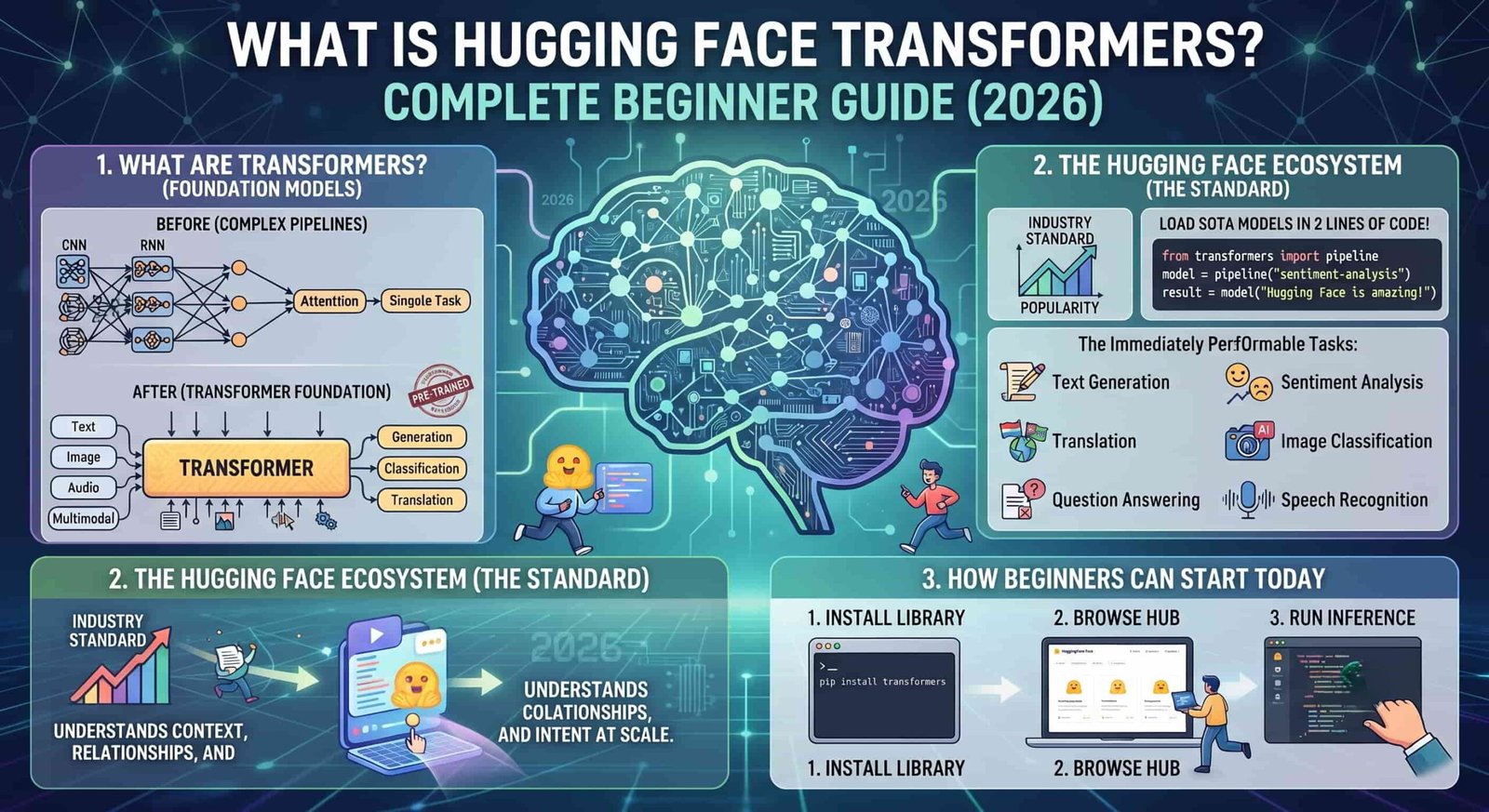
What Is Hugging Face Transformers? Complete Beginner Guide (2026)
Introduction
If Hugging Face is often called the GitHub of Artificial Intelligence, then the Transformers library is the engine that powers much of the modern AI revolution.
Today, many of the world’s most advanced AI applications—including chatbots, virtual assistants, translation systems, coding copilots, content generators, and intelligent search engines—are built using transformer-based models.
For beginners entering AI, Machine Learning, Data Science, or Generative AI, one term appears repeatedly: Transformers.
You might hear developers discussing GPT, BERT, LLaMA, Qwen, Mistral, DeepSeek, Gemma, or other large language models. What many people don’t realize is that most of these models can be loaded and used through a single open-source library called Transformers.
The Hugging Face Transformers library has become one of the most important tools in modern AI development. It simplifies access to thousands of state-of-the-art models and allows developers to build sophisticated AI applications with just a few lines of Python code.
In this guide, you’ll learn what Transformers is, why it became so popular, how it works, its key features, and how beginners can start using it.
What Is Hugging Face Transformers?
Hugging Face Transformers is an open-source Python library that provides a standardized way to download, use, fine-tune, and deploy pre-trained machine learning models.
Instead of manually building complex neural network architectures from scratch, developers can simply load a pre-trained model and begin making predictions immediately.
Think of Transformers as a universal interface for modern AI models.
Whether you want to use:
- GPT-style language models
- BERT-based text classifiers
- Vision Transformers (ViT)
- Image generation models
- Speech recognition systems
- Multimodal AI models
the Transformers library provides a consistent API for working with them.
This dramatically reduces development time and makes advanced AI accessible to developers of all skill levels.
Why Was Transformers Created?
Before Transformers became popular, using state-of-the-art machine learning models was often complicated and time-consuming.
Researchers typically released:
- Research papers
- Model architecture descriptions
- Training methodologies
However, implementing these models often required hundreds or thousands of lines of code.
Developers needed to:
- Rebuild architectures manually
- Handle tokenizer implementations
- Download model weights
- Configure hardware settings
- Optimize inference pipelines
This created significant barriers to adoption.
The Hugging Face team solved this problem by creating a standardized framework that allows developers to access advanced AI models through a simple and consistent interface.
Today, millions of developers use Transformers because it removes much of the complexity associated with machine learning engineering.
What Does “Transformer” Mean?
The term “Transformer” originates from a groundbreaking research paper published by Google researchers in 2017 titled:
“Attention Is All You Need”
This paper introduced the Transformer architecture, which revolutionized natural language processing and eventually became the foundation for:
- GPT
- ChatGPT
- BERT
- Gemini
- LLaMA
- Qwen
- Mistral
- Claude-like systems
- Modern multimodal AI
The key innovation was a mechanism called Self-Attention.
Instead of processing words sequentially like older neural networks, transformers can analyze relationships between all words simultaneously.
This allows models to better understand context, meaning, and long-range dependencies in language.
Why Is Transformers So Popular?
The success of the Transformers library comes from its simplicity and flexibility.
Developers can access powerful AI models without needing deep expertise in machine learning architecture design.
Several factors contributed to its popularity:
Massive Model Support
The library supports thousands of models contributed by organizations including:
- Meta
- Microsoft
- Alibaba
- Mistral AI
- Stability AI
- OpenAI-compatible communities
Consistent API
Regardless of which model you use, the coding experience remains largely the same.
Cross-Framework Compatibility
Transformers supports:
- PyTorch
- TensorFlow
- JAX
This allows developers to work within their preferred machine learning ecosystem.
Production Readiness
The library is widely used in enterprise applications, startups, research labs, and academic institutions.
How Transformers Works
At a high level, the workflow is remarkably simple.
A developer selects a model from the Hugging Face Hub, downloads it through the Transformers library, and begins performing inference.
The process looks like this:
User Input
      │
      ▼
Tokenizer
      │
      ▼
Transformer Model
      │
      ▼
Prediction / Generated Output
The tokenizer converts text into numerical representations that the model can understand.
The transformer model processes those numbers using billions of learned parameters.
The output is then converted back into human-readable text, classifications, summaries, translations, or other results.
Common Tasks Supported by Transformers
The library supports a wide range of AI applications.
Natural Language Processing
Examples include:
- Text generation
- Question answering
- Translation
- Sentiment analysis
- Summarization
- Named entity recognition
Computer Vision
Examples include:
- Image classification
- Object detection
- Image captioning
- Visual question answering
Speech Processing
Examples include:
- Speech-to-text
- Audio classification
- Voice recognition
- Language identification
Multimodal AI
Examples include:
- Image understanding
- Vision-language assistants
- Document analysis
- Image-to-text generation
A Simple Example
One reason developers love Transformers is how quickly results can be achieved.
For example, a sentiment analysis model can be loaded in just a few lines of code:
from transformers import pipeline

classifier = pipeline("sentiment-analysis")

result = classifier(
    "I love learning Artificial Intelligence."
)

print(result)
The model automatically downloads, loads, and performs inference.
The output might look similar to:
POSITIVE
Score: 0.999
Without Transformers, implementing the same functionality would require significantly more effort.
Popular Models Available Through Transformers
The library supports many of the most powerful AI models available today.
| Model | Organization | Primary Use |
|---|---|---|
| LLaMA | Meta | General AI |
| Qwen | Alibaba | Coding & Reasoning |
| Mistral | Mistral AI | Enterprise AI |
| Gemma | Lightweight AI | |
| DeepSeek | DeepSeek AI | Programming |
| BERT | Classification | |
| Whisper | OpenAI | Speech Recognition |
| FLUX | Black Forest Labs | Image Generation |
This diversity allows developers to choose models based on specific project requirements.
Transformers for Data Scientists
Data Scientists frequently use Transformers for:
- Text analytics
- Sentiment analysis
- Classification tasks
- Research experiments
- Feature extraction
- Embedding generation
The library provides access to advanced AI capabilities without requiring large-scale model training.
This accelerates experimentation and reduces development costs.
Transformers for AI Engineers
AI Engineers often use Transformers to build:
- Chatbots
- AI assistants
- RAG systems
- Enterprise search platforms
- Customer support automation
- Document intelligence solutions
The library integrates easily into production workflows and supports deployment across cloud and on-premise environments.
Is Transformers Free?
Yes.
The Hugging Face Transformers library is open source and free to use.
Developers can install it directly using Python package managers and begin experimenting immediately.
Some hosted infrastructure services may have associated costs, but the core library itself is freely available.
The Future of Transformers
As AI continues evolving, the Transformers ecosystem remains at the center of innovation.
New models are being released at an unprecedented pace, and the library continues expanding to support:
- Larger language models
- Smaller efficient models
- Multimodal AI systems
- Agentic workflows
- Advanced reasoning architectures
For anyone pursuing a career in Data Science, Machine Learning, or Artificial Intelligence, understanding Transformers is rapidly becoming a foundational skill.
Conclusion
Hugging Face Transformers is one of the most important libraries in modern Artificial Intelligence.
It provides a simple, consistent, and powerful interface for working with thousands of cutting-edge AI models. Whether you’re building chatbots, analyzing text, processing images, generating content, or deploying enterprise AI systems, Transformers dramatically simplifies the development process.
For beginners, it offers one of the fastest paths into practical AI development. For experienced engineers, it provides the flexibility and scalability needed for production-grade systems.
Learning Transformers today is an investment that will continue paying dividends throughout the future of AI.