

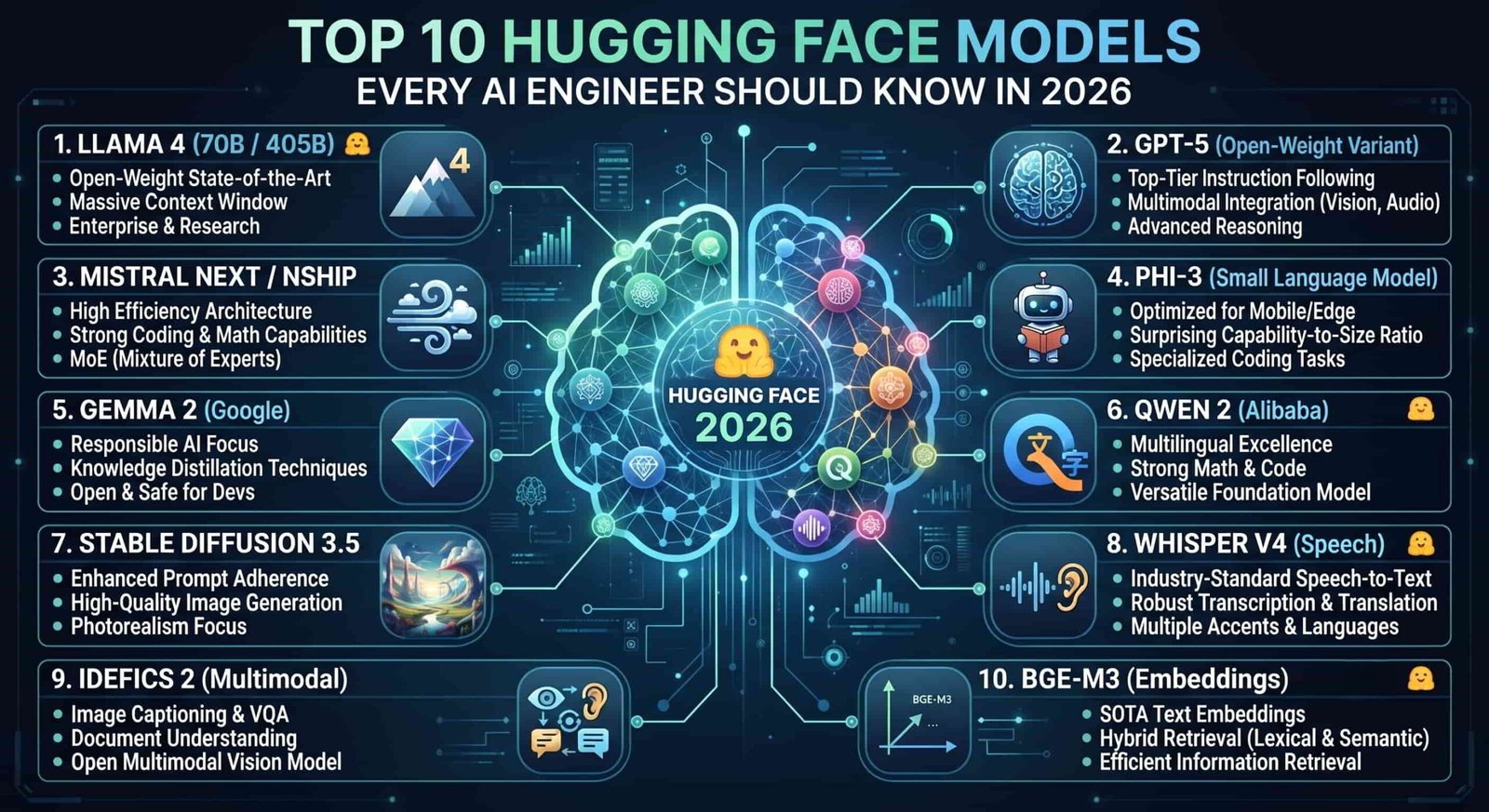
Top 10 Hugging Face Models Every AI Engineer Should Know in 2026
Introduction
The rapid growth of Artificial Intelligence has created an unprecedented demand for powerful foundation models capable of understanding language, generating content, writing code, analyzing images, and solving complex reasoning tasks. While thousands of AI models are available today, only a small percentage have achieved widespread adoption among developers, researchers, startups, and enterprises.
The Hugging Face ecosystem has become the primary hub for discovering and deploying these models. It hosts hundreds of thousands of machine learning models contributed by organizations such as Meta, Google DeepMind, Mistral AI, Alibaba Cloud, Microsoft, Stability AI, and OpenAI-compatible communities.
For AI Engineers, selecting the right model is often more important than choosing a programming language or framework. Different models excel at different tasks. Some are optimized for reasoning, some for coding, others for multilingual communication, image generation, or speech processing.
This guide explores ten of the most influential Hugging Face models that every AI Engineer should understand in 2026.
How to Evaluate an AI Model
Before comparing models, it is important to understand the factors that determine model quality.
A strong foundation model is not simply the largest model available. Engineers typically evaluate models based on reasoning ability, coding performance, multilingual support, inference speed, deployment flexibility, hardware requirements, and licensing restrictions.
The ideal model for a chatbot may not be the ideal model for document analysis or image generation. Understanding these trade-offs helps organizations select the right tool for specific business requirements.
1. LLaMA
Developed By
Meta AI
Category
Large Language Model (LLM)
Best For
- Chatbots
- Reasoning
- Enterprise AI
- Retrieval-Augmented Generation (RAG)
LLaMA has become one of the most influential open-source language model families ever released. It demonstrated that open-source models could compete directly with proprietary systems while maintaining deployment flexibility.
Many modern AI startups build products on top of LLaMA because it provides strong reasoning capabilities and a vibrant ecosystem of community fine-tunes.
LLaMA is particularly popular in enterprise environments where organizations want full control over infrastructure and data privacy.
2. Qwen
Developed By
Alibaba Cloud
Category
Multilingual Large Language Model
Best For
- Coding
- Mathematics
- Multilingual Tasks
- Research
Qwen has emerged as one of the strongest open-source competitors in the AI landscape. It performs exceptionally well across coding benchmarks, mathematical reasoning tasks, and multilingual communication.
Many developers consider Qwen one of the most balanced open-source models available today due to its strong performance across diverse workloads.
Its support for multiple languages makes it especially attractive for global applications.
3. Mistral
Developed By
Mistral AI
Category
Efficient Language Model
Best For
- Production Systems
- Enterprise Applications
- Cost Optimization
Mistral became popular because it demonstrated that smaller and more efficient models could achieve remarkable performance.
Instead of relying solely on scale, Mistral focuses on architectural efficiency and optimized inference performance.
Organizations frequently choose Mistral when they need high-quality results without the infrastructure costs associated with extremely large models.
4. DeepSeek
Developed By
DeepSeek AI
Category
Reasoning and Coding Model
Best For
- Software Development
- Algorithm Design
- Technical Analysis
DeepSeek gained significant attention because of its exceptional coding capabilities and strong logical reasoning performance.
Many engineers use DeepSeek for:
- Code generation
- Code review
- Debugging
- Technical documentation
- Algorithm explanations
Its rapid adoption demonstrates how quickly open-source AI continues to advance.
5. Gemma
Developed By
Google DeepMind
Category
Lightweight Foundation Model
Best For
- Local AI
- Edge Devices
- Personal Projects
Gemma was designed to bring advanced AI capabilities to smaller hardware environments.
Unlike very large models that require expensive GPU infrastructure, Gemma can often run efficiently on more modest systems.
This makes it attractive for developers experimenting with local AI deployments and resource-constrained environments.
6. Phi
Developed By
Microsoft
Category
Small Language Model (SLM)
Best For
- Mobile Applications
- Lightweight AI
- Fast Inference
Microsoft’s Phi family demonstrates that smaller models can deliver surprisingly strong performance when trained effectively.
Phi models are particularly useful when:
- Low latency is required
- Hardware resources are limited
- Deployment costs must be minimized
They are increasingly used in edge AI and mobile applications.
7. FLUX
Developed By
Black Forest Labs
Category
Image Generation Model
Best For
- AI Art
- Advertising Creatives
- Design Workflows
FLUX has quickly become one of the most discussed image generation models in the AI community.
The model produces highly detailed and photorealistic images while offering excellent prompt adherence.
Designers, marketers, and content creators frequently use FLUX to generate visual assets for campaigns, websites, and social media.
8. Stable Diffusion XL
Developed By
Stability AI
Category
Diffusion Model
Best For
- Image Generation
- Product Design
- Creative Content
Stable Diffusion helped democratize AI image generation by making powerful diffusion models openly accessible.
The XL version improved image quality, realism, prompt accuracy, and artistic flexibility.
It remains one of the most widely used image generation models on Hugging Face.
9. Whisper
Developed By
OpenAI
Category
Speech Recognition Model
Best For
- Transcription
- Audio Processing
- Language Translation
Whisper transformed speech-to-text technology by providing highly accurate multilingual transcription capabilities.
Organizations use Whisper for:
- Meeting transcription
- Podcast processing
- Video captioning
- Voice analytics
Its support for multiple languages makes it valuable for global deployments.
10. BERT
Developed By
Category
Language Understanding Model
Best For
- Classification
- Search
- Information Retrieval
Although newer models receive more attention, BERT remains one of the most influential models in AI history.
Many enterprise applications continue to rely on BERT for:
- Search ranking
- Document classification
- Entity extraction
- Recommendation systems
Understanding BERT remains important for every AI professional.
Model Comparison
| Model | Best Use Case | Strength |
|---|---|---|
| LLaMA | General AI | Reasoning |
| Qwen | Coding | Multilingual Intelligence |
| Mistral | Production AI | Efficiency |
| DeepSeek | Programming | Technical Reasoning |
| Gemma | Local AI | Lightweight Deployment |
| Phi | Edge AI | Fast Inference |
| FLUX | Image Generation | Photorealism |
| Stable Diffusion XL | Creative Design | Flexibility |
| Whisper | Speech Processing | Transcription |
| BERT | NLP Applications | Language Understanding |
Which Model Should You Choose?
The answer depends entirely on your goals.
If you need advanced reasoning, LLaMA and Qwen are excellent choices. For coding-focused workflows, DeepSeek and Qwen often perform exceptionally well. Organizations prioritizing efficiency frequently select Mistral. Developers working with local deployments may prefer Gemma or Phi.
For visual content generation, FLUX and Stable Diffusion remain industry favorites, while Whisper continues to dominate speech recognition tasks.
Rather than searching for a single “best” model, successful AI Engineers learn how to match the right model to the right problem.
The Future of Open-Source AI Models
The pace of innovation in open-source AI is accelerating rapidly. New models are appearing every month with improvements in reasoning, efficiency, multimodal understanding, and deployment flexibility.
Platforms like Hugging Face have made these advancements accessible to developers worldwide, reducing the gap between open-source and proprietary AI systems.
Over the next few years, organizations will increasingly combine multiple specialized models rather than relying on a single foundation model for every task.
Conclusion
The Hugging Face ecosystem offers one of the richest collections of AI models available today. Understanding the strengths, weaknesses, and ideal use cases of these models is becoming a critical skill for Data Scientists, Machine Learning Engineers, and AI Engineers.
Whether you are building chatbots, coding assistants, image generators, speech systems, or enterprise AI applications, the models covered in this guide provide an excellent starting point for exploring the modern AI landscape.