

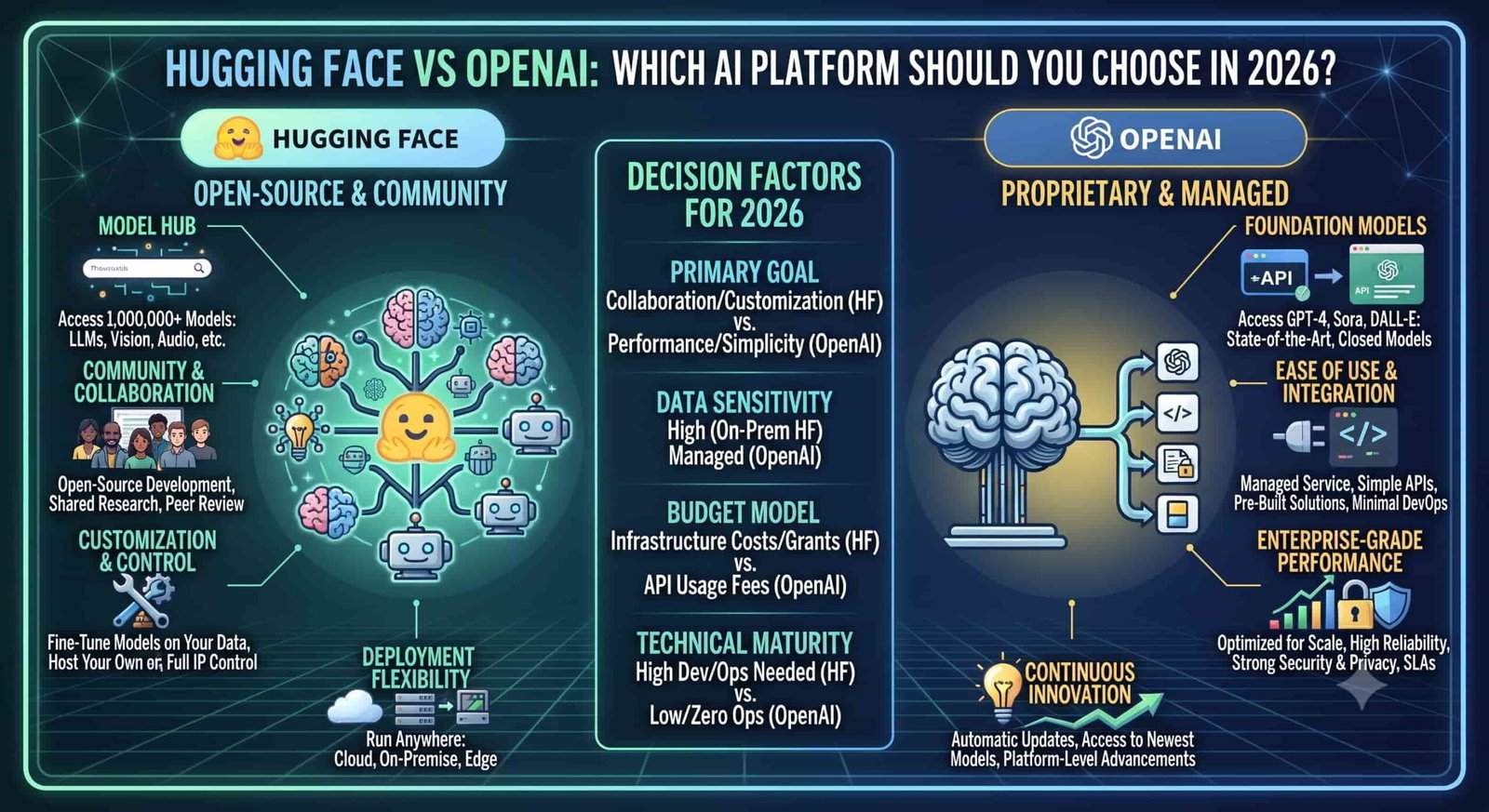
Hugging Face vs OpenAI: Which AI Platform Should You Choose in 2026?
Introduction
Artificial Intelligence has evolved rapidly over the last few years, and two names consistently appear at the center of that transformation: OpenAI and Hugging Face. While both organizations play critical roles in advancing AI, they serve fundamentally different purposes within the ecosystem.
OpenAI is best known for developing powerful proprietary models such as GPT, ChatGPT, DALL·E, and advanced reasoning systems. Hugging Face, on the other hand, has become the leading platform for open-source AI collaboration, hosting hundreds of thousands of machine learning models, datasets, and applications.
For beginners entering the AI field, the distinction is often confusing. Many people assume Hugging Face is a competitor to OpenAI in the same way that two software companies compete. In reality, the relationship is much more nuanced. OpenAI primarily develops AI models, while Hugging Face provides the infrastructure and ecosystem that enables developers to discover, share, fine-tune, and deploy AI models from many organizations—including Meta, Google, Mistral, Microsoft, Alibaba, and countless independent researchers.
Understanding the strengths and limitations of each platform is important for developers, data scientists, AI engineers, startups, and enterprises making technology decisions in 2026 and beyond.
Understanding the Core Difference
The easiest way to understand the difference is through a simple analogy.
OpenAI is similar to a car manufacturer. It designs and builds advanced vehicles that users can drive.
Hugging Face is more like a global automotive marketplace where vehicles from many manufacturers can be discovered, compared, customized, and shared.
OpenAI focuses on creating advanced foundation models and offering access through APIs and products such as ChatGPT. Hugging Face focuses on building the ecosystem where AI models can be hosted, distributed, fine-tuned, evaluated, and deployed.
This distinction affects everything from pricing and flexibility to deployment options and long-term ownership.
Platform Comparison
| Category | OpenAI | Hugging Face |
|---|---|---|
| Primary Focus | Proprietary AI Models | Open-Source AI Ecosystem |
| Popular Products | ChatGPT, GPT, DALL·E | Hub, Transformers, Datasets, Spaces |
| Model Access | API-Based | Download & Self-Host |
| Open Source | Limited | Extensive |
| Customization | Moderate | Very High |
| Infrastructure Control | Managed by OpenAI | User Controlled |
| Deployment Flexibility | Limited | Extensive |
| Community Contributions | Limited | Massive |
| Learning Resources | Strong | Strong |
| Enterprise Adoption | Very High | Very High |
OpenAI’s Strengths
OpenAI has established itself as one of the most influential AI companies in the world by delivering highly capable foundation models that consistently perform at the forefront of the industry.
The biggest advantage of OpenAI is simplicity. Developers can access powerful language models through APIs without worrying about infrastructure management, GPU provisioning, model optimization, or deployment complexities. A startup can integrate GPT-powered capabilities into an application within hours rather than weeks.
Another significant strength is model quality. OpenAI models frequently rank among the best-performing systems in reasoning, coding, content generation, summarization, and conversational AI. This allows organizations to focus on product development rather than model engineering.
OpenAI also offers enterprise-grade reliability, security features, monitoring tools, and global infrastructure that make it attractive for large-scale production deployments.
Hugging Face’s Strengths
Hugging Face approaches AI from a completely different direction. Instead of building a single family of models, it enables access to a massive ecosystem of open-source innovation.
One of the platform’s greatest strengths is freedom. Developers can choose from hundreds of thousands of models covering language processing, computer vision, speech recognition, multimodal AI, diffusion models, embedding models, and more.
Unlike proprietary APIs, many Hugging Face models can be downloaded and run locally. Organizations maintain full ownership of their infrastructure, data, and deployment strategies. This level of control is particularly valuable for industries with strict privacy, compliance, or regulatory requirements.
The platform also encourages experimentation. Developers can compare multiple models, fine-tune them for specific use cases, and deploy them using their own cloud environments.
For AI researchers and engineers who want flexibility and transparency, Hugging Face offers significant advantages.
Open Source vs Proprietary AI
One of the biggest differences between the two platforms is their philosophy toward AI development.
OpenAI primarily operates using a proprietary model strategy. While developers can access models through APIs, the underlying model weights and training processes remain private.
This approach provides benefits such as:
- Consistent quality
- Simplified deployment
- Managed infrastructure
- Enterprise reliability
However, it also creates limitations. Organizations are dependent on pricing structures, API availability, and vendor decisions.
Hugging Face embraces an open-source ecosystem where many models are publicly accessible. Developers can inspect architectures, fine-tune weights, modify behavior, and deploy systems independently.
This provides greater transparency and flexibility but may require additional technical expertise.
Cost Considerations
Pricing often becomes an important factor when selecting an AI platform.
OpenAI generally follows a usage-based pricing model. Organizations pay according to the number of tokens processed, API requests made, or services consumed.
This model works well for teams that want predictable infrastructure management and minimal operational overhead.
Hugging Face presents more options. Developers can use many models for free, host them locally, deploy them on their own cloud infrastructure, or utilize Hugging Face’s managed services.
For small experiments, Hugging Face can be extremely cost-effective. For large-scale deployments, costs depend heavily on compute requirements and infrastructure choices.
Which Platform Is Better for Data Scientists?
Data Scientists often need flexibility for experimentation, model comparison, benchmarking, and research workflows.
In these situations, Hugging Face frequently provides more value because it offers access to a wide variety of models and datasets. Data scientists can test multiple approaches, fine-tune models, and evaluate performance without being locked into a single vendor ecosystem.
OpenAI remains useful for rapid prototyping and evaluating state-of-the-art capabilities, but Hugging Face generally offers more freedom for research-oriented work.
Which Platform Is Better for AI Engineers?
For AI Engineers, the answer depends on project requirements.
If the goal is to build an application quickly using highly capable language models, OpenAI often provides the fastest path to production.
If the goal is to build custom AI systems, fine-tune models, deploy locally, implement Retrieval-Augmented Generation (RAG), or maintain full infrastructure control, Hugging Face usually becomes the preferred option.
Many modern AI engineers actually use both platforms together.
Can Hugging Face and OpenAI Be Used Together?
Absolutely.
In fact, many organizations combine both ecosystems.
A company might use OpenAI’s GPT models for advanced reasoning tasks while simultaneously using Hugging Face models for embeddings, speech recognition, image classification, or custom domain-specific workflows.
This hybrid approach allows teams to leverage the strengths of both platforms while minimizing limitations.
Rather than viewing them as competitors, it is often more accurate to think of them as complementary components within a larger AI stack.
The Future of AI Development
The future of AI is unlikely to be dominated by a single platform.
Proprietary providers such as OpenAI will continue pushing the boundaries of model performance, reasoning, and enterprise capabilities. At the same time, open-source ecosystems led by platforms like Hugging Face will continue driving transparency, innovation, customization, and community collaboration.
Organizations that understand both ecosystems will be better positioned to adapt as AI technology evolves.
The most successful AI professionals of the next decade will likely be comfortable working with proprietary APIs and open-source models alike.
Conclusion
OpenAI and Hugging Face are both essential pillars of the modern AI ecosystem, but they solve different problems.
OpenAI excels at delivering powerful, production-ready AI capabilities through managed services and proprietary models. Hugging Face excels at providing flexibility, openness, experimentation, and access to a vast ecosystem of community-driven innovation.
For beginners, OpenAI often provides the fastest path to building AI applications. For developers seeking customization, ownership, and open-source flexibility, Hugging Face offers unparalleled opportunities.
In practice, many organizations benefit from using both platforms together. Understanding when to leverage each approach is becoming an increasingly valuable skill for Data Scientists, Machine Learning Engineers, AI Engineers, and technology leaders.