

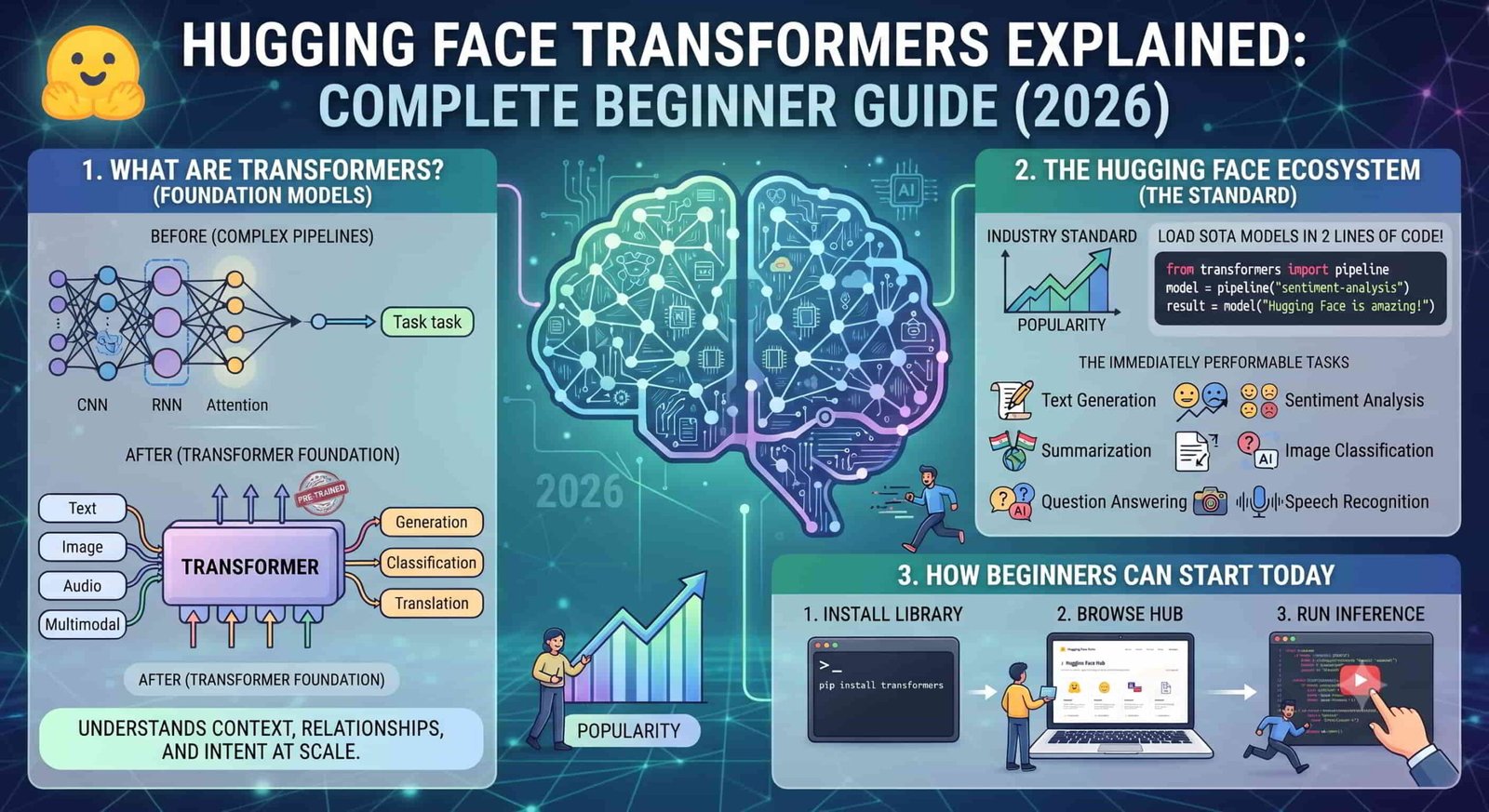
Hugging Face Transformers Explained: Complete Beginner Guide (2026)
Introduction
Modern Artificial Intelligence applications—from AI chatbots and virtual assistants to translation systems, recommendation engines, and content generation tools—are powered by a breakthrough technology known as Transformers.
Over the last few years, Transformers have fundamentally changed how machines understand language, images, audio, and even combinations of multiple data types. Technologies such as ChatGPT, Gemini, Claude, LLaMA, Mistral, and Qwen all rely on transformer-based architectures.
While the underlying concepts can seem intimidating at first, developers today rarely need to build transformer models from scratch. Instead, they can leverage the Hugging Face Transformers library, one of the most popular open-source frameworks in the AI industry.
The library provides access to thousands of state-of-the-art models through a simple and consistent interface. Whether you’re building a chatbot, performing sentiment analysis, translating languages, generating content, or analyzing documents, the Transformers library dramatically simplifies the development process.
In this guide, you’ll learn what the Hugging Face Transformers library is, how it works, why it has become an industry standard, and how beginners can start using it effectively.
What Is the Hugging Face Transformers Library?
The Hugging Face Transformers library is an open-source Python framework that provides a unified way to work with modern machine learning models. Instead of requiring developers to learn different APIs and implementation methods for every model architecture, the library offers a consistent interface across thousands of AI models.
Think of it as a universal toolkit for Artificial Intelligence.
Just as a web developer can use frameworks like React or Django to build applications more efficiently, AI developers use Transformers to access powerful machine learning capabilities without building everything from scratch.
The library supports a wide variety of AI domains, including:
- Natural Language Processing (NLP)
- Computer Vision
- Speech Recognition
- Audio Processing
- Multimodal AI
- Generative AI
Today, millions of developers, researchers, startups, and enterprises use Transformers as a foundational component of their AI workflows.
┌─────────────────────────────────────┐
│      Hugging Face Transformers      │
└─────────────────────────────────────┘
                  │
      ┌───────────┼───────────┐
      │           │           │
      ▼           ▼           ▼

   GPT        LLaMA      Mistral

      ▼           ▼           ▼

   Same API   Same API   Same API
One of the biggest advantages of the library is that developers can switch between different models while using nearly identical code structures.
Why Was the Transformers Library Created?
Before transformer-based frameworks became widely available, implementing modern machine learning models was often complicated and time-consuming.
Researchers would publish groundbreaking models, but reproducing those models required deep expertise, specialized hardware, and extensive engineering effort. Different models often used different architectures, training procedures, and APIs, creating significant friction for developers.
The Hugging Face team recognized this challenge and introduced the Transformers library as a standardized ecosystem that could bridge the gap between research and practical application development.
Instead of spending weeks implementing research papers, developers could simply download a pre-trained model and start building immediately.
This approach dramatically accelerated AI adoption by making advanced machine learning more accessible to students, developers, researchers, and businesses around the world.
Some of the key benefits introduced by the library include:
- Access to pre-trained models
- Standardized APIs
- Faster experimentation
- Easier deployment
- Community collaboration
- Open-source innovation
As a result, the library quickly became one of the most influential tools in the modern AI ecosystem.
Understanding Transformer Models
To understand the Transformers library, it is helpful to understand what a transformer model actually is.
Transformers are a type of deep learning architecture introduced in Google’s landmark 2017 research paper titled:
“Attention Is All You Need.”
Before transformers, many language models relied on recurrent neural networks (RNNs) and long short-term memory networks (LSTMs). While effective for certain tasks, these architectures struggled to process long sequences efficiently and often lost contextual information.
Transformers introduced a new mechanism called Self-Attention, which allows a model to examine relationships between all words in a sentence simultaneously.
For example:
The dog chased the ball because it was excited.Humans naturally understand that “it” refers to “the dog.”
Traditional models often struggled with this type of contextual relationship. Transformers, however, can identify these connections much more effectively through attention mechanisms.
This innovation significantly improved language understanding and became the foundation of modern Large Language Models (LLMs).
How Transformers Work
At a high level, transformer models process information through several stages before generating predictions.
Input Text
     │
     ▼
Tokenization
     │
     ▼
Embeddings
     │
     ▼
Self-Attention Layers
     │
     ▼
Feed Forward Layers
     │
     ▼
Predictions
Each stage plays an important role in helping the model understand and process information.
Step 1: Tokenization
Computers cannot directly understand human language. The first step is converting text into smaller units called tokens.
For example:
Input:
I love Artificial Intelligence
May become:
["I", "love", "Artificial", "Intelligence"]or numerical representations such as:
[101, 2548, 8932, 6742]depending on the tokenizer being used.
Tokenization transforms language into a format that neural networks can process.
Step 2: Embeddings
After tokenization, each token is converted into a numerical vector known as an embedding.
These vectors capture semantic relationships between words.
For example:
AI → [0.23, 0.84, 0.12, ...]Words with similar meanings often have similar vector representations.
This allows models to understand relationships such as:
- King ≈ Queen
- Car ≈ Vehicle
- Doctor ≈ Physician
Embeddings serve as the foundation for deeper contextual understanding.
Step 3: Self-Attention
Self-attention is the core innovation behind transformer models.
Instead of processing words sequentially, transformers analyze relationships between all words simultaneously.
Sentence

Word 1 ─────► Word 2
   │            ▲
   ▼            │
Word 3 ◄───── Word 4
The model learns which words are most important for understanding meaning.
For example, when reading:
The cat sat on the mat because it was tired.The model can determine that “it” refers to “the cat” rather than “the mat.”
This contextual understanding is one reason transformers outperform earlier architectures.
Step 4: Deep Transformer Layers
Modern transformer models contain multiple stacked layers that progressively refine their understanding.
Each layer processes information and passes enhanced representations to the next layer.
Examples include:
| Model | Approximate Layers |
|---|---|
| BERT Base | 12 |
| GPT-2 | 48 |
| LLaMA | 80+ |
| Qwen | 80+ |
| Mistral Large | 80+ |
The greater the number of layers and parameters, the more complex patterns the model can learn.
Popular Models Available Through Transformers
The Hugging Face ecosystem supports thousands of models spanning multiple domains.
Large Language Models
- LLaMA
- Qwen
- Mistral
- Gemma
- DeepSeek
Natural Language Processing Models
- BERT
- RoBERTa
- T5
- DistilBERT
Speech Models
- Whisper
- Wav2Vec
Vision Models
- Vision Transformer (ViT)
- DETR
- CLIP
Multimodal Models
- LLaVA
- Qwen-VL
- Florence
These models can be used for tasks ranging from content generation to image understanding and speech transcription.
Running Your First Transformer Model
One reason the Transformers library has become so popular is its simplicity.
With only a few lines of code, developers can perform complex AI tasks.
from transformers import pipeline

classifier = pipeline(
    "sentiment-analysis"
)

result = classifier(
    "This AI tool is amazing."
)

print(result)
Expected output:
POSITIVEBehind the scenes, the library automatically downloads the model, loads the tokenizer, performs inference, and returns predictions.
Without the library, implementing this workflow would require significantly more code and engineering effort.
Common Tasks Supported by Transformers
The library supports a wide range of machine learning tasks.
Natural Language Processing
- Text Generation
- Sentiment Analysis
- Summarization
- Translation
- Question Answering
- Text Classification
Computer Vision
- Image Classification
- Object Detection
- Image Segmentation
Audio Processing
- Speech Recognition
- Audio Classification
- Speaker Identification
Multimodal AI
- Visual Question Answering
- Image Captioning
- Document Understanding
This flexibility makes the library useful across many industries and applications.
Why AI Engineers Love Transformers
The Hugging Face Transformers library has become a favorite among AI Engineers because it significantly reduces development complexity.Instead of spending months implementing and optimizing models, engineers can focus on solving business problems and building products.
Major advantages include:
Unified Interface
A single API works across thousands of models.
Faster Prototyping
Ideas can be tested in hours rather than weeks.
Open-Source Ecosystem
Large community support and contributions.
Production Readiness
Suitable for both experimentation and enterprise deployment.
Extensive Documentation
Comprehensive learning resources for beginners and professionals.
These benefits have made the library a cornerstone of modern AI engineering.
Real-World Applications
Organizations use transformer-based models across numerous industries.
| Industry | Use Case |
|---|---|
| Healthcare | Clinical document analysis |
| Finance | Fraud detection and risk assessment |
| Education | AI tutors and learning assistants |
| Retail | Product recommendations |
| Customer Support | Intelligent chatbots |
| Legal | Contract analysis |
| Media | Content generation and summarization |
The versatility of transformers continues to drive adoption across sectors.
Challenges and Limitations
Despite their impressive capabilities, transformers are not perfect.
High Computational Requirements
Large models often require powerful GPUs and significant memory.
Hallucinations
Models may generate incorrect or fabricated information.
Latency
Very large models can introduce response delays.
Fine-Tuning Complexity
Customizing models for specific domains may require advanced expertise. Understanding these limitations is essential when deploying AI systems in production environments.
How Beginners Can Start Learning Transformers
If you are new to AI, follow a structured learning path.
Step 1
Learn Python fundamentals.
Step 2
Understand Machine Learning concepts.
Step 3
Explore Natural Language Processing basics.
Step 4
Install the Transformers library.
Step 5
Experiment with pre-trained models.
Step 6
Build small AI projects.
Step 7
Learn fine-tuning and deployment techniques.
Consistent hands-on practice is the fastest way to develop expertise.
The Future of Transformers
Transformers continue to serve as the foundation for many of today’s most advanced AI systems.
They power:
- Large Language Models
- AI Agents
- Multimodal Systems
- Enterprise AI Applications
- Scientific Research Platforms
- Autonomous Systems
Although new architectures continue to emerge, transformers remain the dominant framework driving innovation across the AI industry.
As model efficiency improves and hardware becomes more powerful, transformer-based systems will likely become even more integrated into everyday technology.
Conclusion
The Hugging Face Transformers library has transformed the way developers build Artificial Intelligence applications. By providing a unified interface to thousands of state-of-the-art models, it allows beginners and professionals alike to access advanced AI capabilities with minimal complexity.
Whether you’re interested in Data Science, Machine Learning, AI Engineering, Deep Learning, or Generative AI, learning the Transformers library is one of the most valuable investments you can make in your AI journey.
As Artificial Intelligence continues to evolve, understanding how transformer models work will remain a foundational skill for the next generation of technology professionals.