

What Is Hugging Face? Complete Beginner Guide (2026)
Introduction
If you have spent any time exploring Artificial Intelligence, Machine Learning, or Generative AI, you have almost certainly encountered the name Hugging Face.
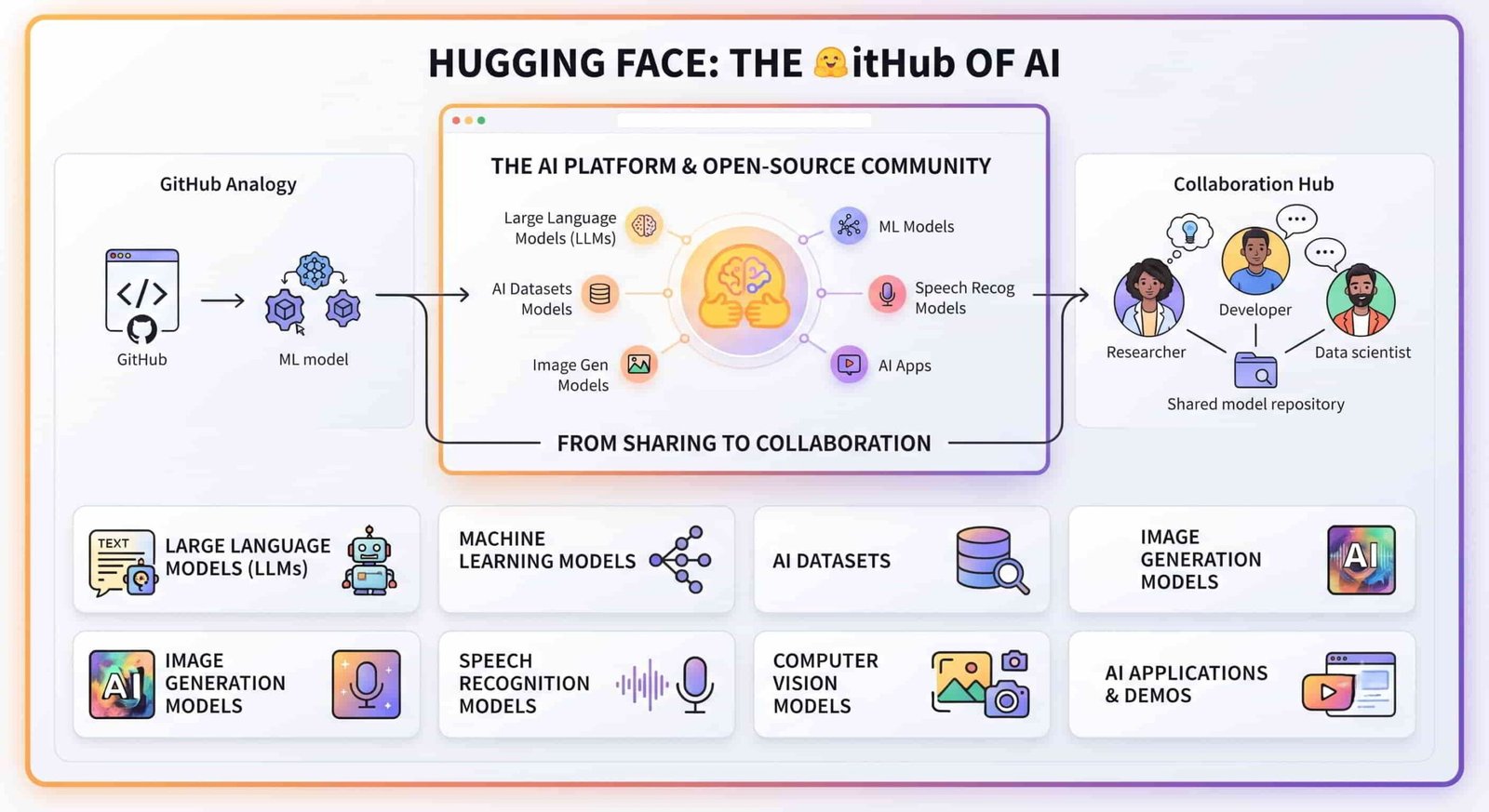
While many beginners initially assume it is just another private AI software company, Hugging Face has become the foundational infrastructure of the modern open-source AI ecosystem. Often described as the “GitHub of Machine Learning,” it serves as the central hub where millions of developers, researchers, and enterprises collaborate, share pre-trained weights, and deploy intelligent applications.
Whether you are fine-tuning a Large Language Model (LLM), building an intelligent chatbot, transcribing audio, or generating photorealistic images, Hugging Face is an indispensable part of modern AI workflows.
In this guide: You will learn what Hugging Face is, why it became the industry standard, its core ecosystem tools, real-world use cases, and how beginners can start building with it today.
What Is Hugging Face?
Hugging Face is a collaborative platform and open-source ecosystem that provides tools, datasets, model hosting, and compute infrastructure for building and deploying machine learning applications.
Just as GitHub allows developers to host, version-control, and share software code, Hugging Face enables the AI community to host and share pre-trained model weights, evaluation datasets, and interactive web demos.
┌─────────────────────────────────────────────────────────────┐
│                    Hugging Face Hub                         │
├─────────────────┬───────────────────┬───────────────────────┤
│ Models          │ Datasets          │ Spaces                │
│ (1M+ Pre-trained│ (100k+ Cleaned    │ (Interactive Streamlit│
│  Weight Files)  │  Training Sets)   │  & Gradio Web Apps)   │
└─────────────────┴───────────────────┴───────────────────────┘
                                ▲
                                │ Integrated via
┌───────────────────────────────┴─────────────────────────────┐
│           Open-Source Python Libraries & Services           │
│  • Transformers   • Diffusers   • Datasets   • Inference API│
└─────────────────────────────────────────────────────────────┘
The platform’s primary mission is to democratize artificial intelligence—making state-of-the-art machine learning accessible, transparent, and collaborative for developers worldwide.
Why Is It Called Hugging Face?
The company originally launched in 2016 as a conversational AI chatbot app designed for teenagers. The app featured a smiling face with open hands emoji (🤗) as its brand identity. While the company eventually pivoted away from consumer chatbots to open-source machine learning infrastructure, the friendly name and signature emoji logo remained, quickly becoming one of the most recognizable icons in tech.
Why Has Hugging Face Become So Popular?
Before Hugging Face gained widespread adoption, implementing state-of-the-art machine learning models was exceptionally difficult. Researchers and software engineers had to write complex low-level code in C++ or raw PyTorch/TensorFlow, provision expensive GPU clusters, and train models from scratch for weeks.
Hugging Face fundamentally transformed this paradigm by introducing:
-
Pre-Trained Model Access: Download and run cutting-edge models trained by research institutions (Meta, Google, Microsoft, Mistral) in minutes.
-
Standardized APIs: Interact with thousands of distinct model architectures using a unified Python syntax.
-
Open Collaboration: Share fine-tuned weights, community benchmarks, and reproducibility evaluations openly.
-
Rapid Prototyping: Build, test, and showcase interactive AI proof-of-concepts without managing web servers.
The Core Pillars of the Hugging Face Ecosystem
Hugging Face is not a single product—it is an interconnected suite of open-source libraries and cloud services.
| Component | Category | Primary Function |
| Hugging Face Hub | Platform | A centralized repository hosting models, datasets, and web demos. |
transformers |
Python Library | Download, run, and fine-tune state-of-the-art NLP, vision, and multimodal models. |
datasets |
Python Library | Stream, filter, and preprocess large-scale datasets with minimal memory overhead. |
diffusers |
Python Library | Tooling for generative diffusion models (e.g., Stable Diffusion, FLUX). |
| Spaces | Cloud Hosting | Free and paid hosting for live Gradio and Streamlit AI demo apps. |
| Inference Endpoints | Infrastructure | Fully managed, production-grade API hosting on dedicated cloud GPUs. |
Deep Dive: Key Platform Features
1. The Model Hub
The Model Hub hosts hundreds of thousands of pre-trained models spanning every major machine learning modality:
-
Natural Language Processing (NLP): Text generation, translation, sentiment analysis, named-entity recognition, and summarization.
-
Computer Vision: Image classification, object detection, depth estimation, and semantic segmentation.
-
Audio & Speech: Speech-to-text transcription, voice cloning, and audio classification.
-
Multimodal AI: Vision-language models (VLMs) that can inspect images and answer questions conversationally.
2. The transformers Library
The transformers library is Hugging Face’s flagship Python package. It allows developers to load models and run predictions with just a few lines of clean code:
from transformers import pipeline

# Load a pre-trained sentiment analysis pipeline
classifier = pipeline("sentiment-analysis")

# Run inference immediately
result = classifier("Hugging Face makes deploying AI remarkably straightforward!")
print(result)
# Output: [{'label': 'POSITIVE', 'score': 0.9998}]
3. Hugging Face Spaces
Spaces enables developers to turn machine learning scripts into interactive web applications using UI frameworks like Gradio and Streamlit. Data scientists use Spaces to build portfolio prototypes, test models publicly, and gather user feedback without setting up complex frontend servers.
4. Serverless Inference API & Dedicated Endpoints
Instead of purchasing expensive dedicated GPUs or configuring Kubernetes clusters, developers can send standard HTTP requests to Hugging Face’s managed endpoints. This allows startups and enterprises to plug open-source LLMs directly into existing mobile and web apps.
Popular Foundation Models Hosted on Hugging Face
| Model Family | Creator / Organization | Primary Capability | Best Use Case |
| LLaMA | Meta | Large Language Model | General reasoning, code generation, chat assistants |
| Mistral / Mixtral | Mistral AI | Efficient Mixture-of-Experts | High-performance enterprise reasoning and RAG |
| Qwen | Alibaba Cloud | Multilingual Foundation LLM | Multilingual chat, mathematics, coding tasks |
| Gemma | Google DeepMind | Lightweight Open Model | On-device inference and local development |
| Whisper | OpenAI | Speech-to-Text | Multilingual audio transcription and translation |
| Stable Diffusion / FLUX | Stability AI / BFL | Latent Diffusion | High-resolution image generation and editing |
| BERT | Bidirectional Encoder | Enterprise search, classification, embedding models |
Real-World Applications Across Industries
Organizations leverage Hugging Face models across diverse business domains:
-
Customer Operations: Deploying private, fine-tuned open-source LLMs for automated technical support ticketing and triage.
-
Financial Risk & Compliance: Running automated document extraction pipelines to parse SEC filings and detect anomalous transactions.
-
Healthcare & Life Sciences: Summarizing clinical notes, processing biomedical research papers, and classifying pathology imagery.
-
E-Commerce & Retail: Generating dynamic product catalog descriptions and powering vector-search visual recommendation engines.
-
Recruiting & HR: Semantic matching between candidate resumes and open job specifications.
Hugging Face for Data Scientists vs. AI Engineers
Both Data Scientists and AI Engineers utilize Hugging Face daily, though with distinct operational focuses:
┌─────────────────────────────────────────────────────────────┐
│                 Data Scientists & Analysts                  │
│ • Exploratory analysis on benchmark datasets (`datasets`)   │
│ • Evaluating baseline model metrics and zero-shot NLP       │
│ • Fine-tuning smaller domain-specific classifiers           │
└─────────────────────────────────────────────────────────────┘
                              vs.
┌─────────────────────────────────────────────────────────────┐
│             AI Engineers & Full-Stack Developers            │
│ • Deploying LLMs to production endpoints (TGI / vLLM)       │
│ • Building Retrieval-Augmented Generation (RAG) pipelines   │
│ • Shipping interactive demo prototypes via Spaces & Gradio  │
└─────────────────────────────────────────────────────────────┘
How to Get Started as a Beginner
You can start using Hugging Face in three simple steps:
-
Create a Free Account: Sign up at huggingface.co to explore trending models, datasets, and community Spaces.
-
Experiment in Google Colab: Install
transformersandtorchin a free Jupyter notebook, and run pre-builtpipeline()tasks for text generation or classification. -
Deploy Your First Space: Write a 15-line Python script using Gradio, push it to a Hugging Face Space repository, and share your live interactive AI web app with the world.